 how-to
Triathlon Technique Drills for Older Athletes: A Guide
Table of Contents
- Why Technique Drills Matter More After 50
- Swimming Technique Drills for Seniors: Fixing the Catch
- Bike Drills That Protect Joint Integrity and Power
- Injury Prevention for Masters Triathletes: Run Form Overhaul
- Recovery Strategies for Aging Triathletes: Active Recovery Days
- Equipment Adaptations for Masters Athletes
- Common Mistakes in Triathlon Technique Drills for Older Athletes
- Conclusion: Building Sustainable Speed
- Frequently Asked Questions
Last Updated: October 4, 2026
Why Technique Drills Matter More After 50
Triathlon technique drills for older athletes are not about chasing your times at 35, they protect the body carrying you through another decade of racing.
The physiology explains why. Muscle mass declines with age (sarcopenia), and bone density drops, especially after menopause.
The good news: technique is trainable at any age. Better biomechanics spread load across muscles and joints instead of concentrating it, meaning fewer injuries, more efficient movement, and speed that lasts.
Swimming Technique Drills for Seniors: Fixing the Catch
Swimming technique drills for seniors should focus first on the catch, the moment your hand enters the water and grabs hold of it. Get it right and you pull more water with less shoulder strain; get it wrong and you slip through the water while your shoulders take a beating.
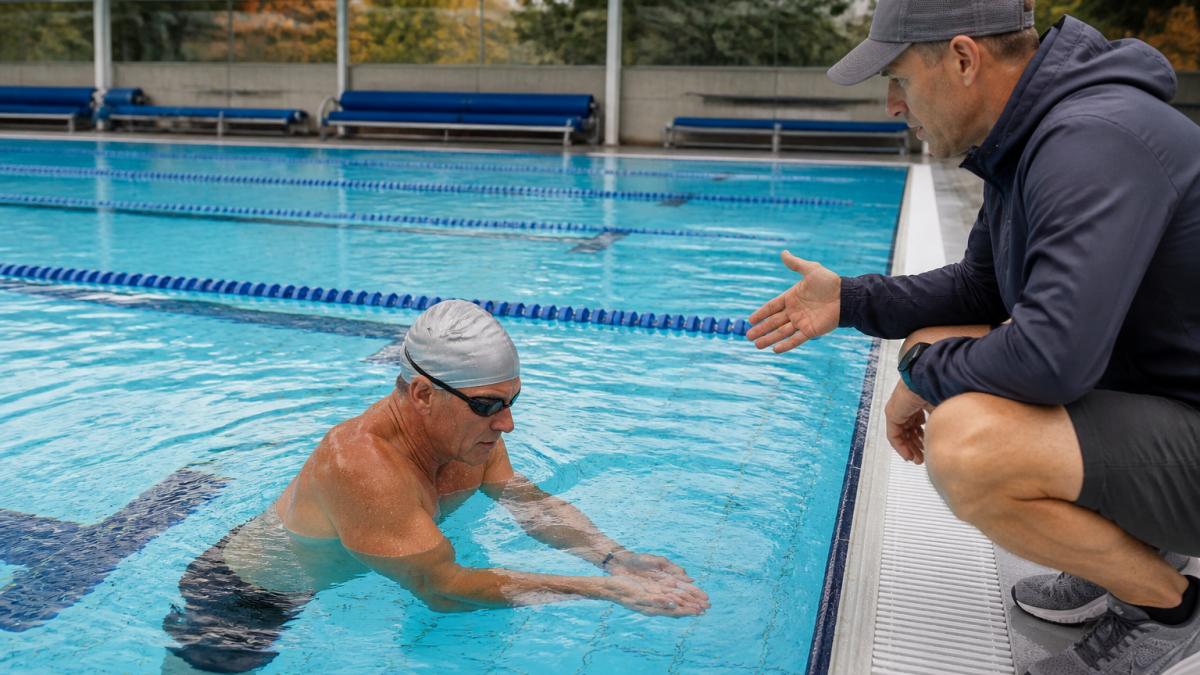
Sculling and Fist Drill Modifications
Sculling teaches you to feel the water: cup your hands and sweep them side to side in front of your chest, 25 meters at a time with rest between lengths.
The fist drill builds the same feel with a twist: swim with closed fists, then open them mid-length, and notice how much water your forearm catches.
For older swimmers, shorten these drills. Twenty-five meters is plenty. Long drill sets fatigue the shoulders before they teach anything.
Reducing Shoulder Load in the Pull Phase
The pull phase is where most shoulder problems start. Instead of a straight-arm pull, bend the elbow and sweep your hand toward your hip, push water backward, not down.
Rotate your body with each stroke. This lets your bigger back muscles do the work. Your shoulders become guides, not engines.
Bike Drills That Protect Joint Integrity and Power
Bike drills for masters athletes protect joint integrity, a joint's ability to move under load without wear or instability, by keeping knees tracking straight and cadence high, avoiding the grinding, big-gear pedaling that punishes knees and hips.
Start with single-leg drills on an indoor trainer: unclip one foot and pedal with the other for 30 seconds, exposing dead spots and teaching a smoother circle.
Cadence work comes next: ride at 90 to 100 rpm in an easy gear for five minutes.
Then add spin-ups. Every few minutes, accelerate to a fast cadence for 30 seconds, then settle back. These build neuromuscular control without pounding your joints.
- Single-leg drills: 4-6 x 30 seconds per leg
- Cadence holds: 3-5 x 5 minutes at 90-100 rpm
- Spin-ups: 4-6 x 30 seconds
Injury Prevention for Masters Triathletes: Run Form Overhaul
Injury prevention for masters triathletes starts with the run, which delivers the highest impact forces of the three sports. Over thousands of steps, small form flaws add up.
The fix is not to run less. It is to run lighter.
Cadence Drills and Ground Contact Time
Cadence is your steps per minute. Most age group runners sit at 160 to 170; pushing toward 175 to 180 shortens your stride and cuts ground contact time, meaning less force through knees and hips.
Try this progression:
- Run easy for 10 minutes to warm up
- Run 30 seconds at your normal cadence, counting steps
- Run 30 seconds at a cadence 5 steps higher
- Repeat 6 to 8 times, then cool down
A metronome app helps. Set it to your target cadence and let the beep guide your feet.
Recovery Strategies for Aging Triathletes: Active Recovery Days
Recovery strategies for aging triathletes work best when active, not passive, treat recovery as a skill you drill, like your catch or cadence. A day on the couch does less for your legs than an easy 20-minute spin or short walk.
Active recovery moves blood through tired muscles without adding training stress, clearing metabolic waste and reducing stiffness. Keep the effort genuinely easy, if you cannot hold a conversation, you are training, not recovering.
Recovery Drills, Not Just Recovery Days
Most competitors say take an easy day; fewer say what to do with it. These drills train a specific quality, tissue perfusion, range of motion, or parasympathetic downshift, rather than filling time.
- Leg-flush spin: 20-30 minutes on the trainer at 80-85 rpm, resistance light enough that your heart rate stays under roughly 60% of max. Cadence matters more than power here; the goal is circulation, not load.
- Pool walk and float: 15-20 minutes of walking in chest-deep water, then 5 minutes of relaxed floating with slow exhales. Buoyancy offloads joints while hydrostatic pressure helps move fluid through sore calves and quads.
- Mobility flow: 8-10 minutes of controlled hip, ankle, and thoracic rotations, not static stretching. Hold each position 2-3 seconds and move through the full range you actually have today, not the range you had at 40.
The Longevity Mindset Shift
After 50, the mental game changes as much as the physical one. Athletes who keep racing into their 60s stop asking "how hard can I go today?" and start asking "what can I absorb today and still train tomorrow?"
That reframe is strategy, not softness. A masters athlete training at 85% of their ceiling for 48 weeks a year out-races one who trains at 100% for 20 weeks and spends the rest injured.
Concrete Recovery Numbers
- Sleep: 7-9 hours, with a consistent wake time. Masters athletes who sleep under 7 hours report noticeably slower recovery between hard sessions.
- Protein: aim for roughly 1.2-1.6 grams per kilogram of body weight per day, spread across meals, to support muscle repair as sarcopenia accelerates.
- Active recovery days: 2-3 per week, each 20-40 minutes, all at conversational effort.
Equipment Adaptations for Masters Athletes
Equipment adaptations for masters athletes reduce strain on aging joints without costing speed, but gear changes only help if they unlock a drill you could not otherwise do. A shorter crank lets you hold a high-cadence drill without your hip pinching; a flexible-shoulder wetsuit lets you finish a sculling set without rotator cuff complaints.
Treat every equipment change as a technique enabler, not a comfort purchase.
Swim Gear That Restores Range of Motion
- Flexible-shoulder wetsuit: Look for a suit with a thin, stretchy panel across the lats and shoulders. This restores the reach you need for a high-elbow catch when shoulder mobility has tightened. Without it, most masters swimmers unconsciously shorten their stroke to avoid the pinch.
- Pull buoy: Not a crutch, a diagnostic. Using a buoy removes the kick and forces you to feel whether your catch and rotation are actually doing the work. If your pace collapses without your legs, your upper-body technique is the problem.
- Fins (short, stiff): Short fins let you hold a sculling or fist-drill position long enough to learn it, without the ankle strain long fins cause. Use them for 25-meter drill repeats, not for whole workouts.
Bike Fit Changes That Change Your Technique
- Shorter cranks: Dropping from 172.5 mm to 165 mm (or shorter) opens the hip angle at the top of the pedal stroke. That extra room is what allows you to hold 90-100 rpm in the cadence drills without your knee tracking inward or your hip flexor seizing.
- Raised handlebars: A 1-2 cm rise eases neck and lower-back strain, which in turn lets you stay in the aero position long enough to actually train it. Comfort here is a technique investment, not a concession.
- Saddle with a cutout: Reduces perineal pressure so you can hold position through long cadence sets instead of shifting every 30 seconds.
Run Gear That Supports Form, Not Just Feet
- Cushioned daily trainers: More stack height absorbs impact, which matters as joint cartilage thins. Save the stiff, low-profile shoes for short cadence drills on soft surfaces, not for your long runs.
- Slightly lower drop (4-6 mm): A moderate drop encourages a midfoot landing and supports the higher cadence you are drilling. Going to zero drop overnight is a recipe for calf and Achilles trouble, transition over 8-12 weeks.
- Metronome or cadence app: The single cheapest piece of "equipment" for run technique. Set it to your target cadence and let it pace your drill intervals.
The One Purchase Worth Prioritizing
If you do one thing, get a professional bike fit, and tell the fitter you are a masters athlete doing cadence and single-leg drills, not just chasing aero. Your body has changed since your last fit, and a fit that ignores hip angle and knee tracking will undermine every drill here.
Common Mistakes in Triathlon Technique Drills for Older Athletes
The biggest mistake in triathlon technique drills for older athletes is treating them like fitness sessions. Drills are for form, not fatigue, stop a set when form breaks down, not when the clock says so.
Other common errors:
- Skipping drills because they feel slow
- Doing too many drills in one session
- Ignoring pain signals that point to joint problems
A common mistake is chasing volume when the real limit is recovery rate. More training only helps if you can absorb it.
Conclusion: Building Sustainable Speed
Speed after 50 is built on movement quality, not just effort. Athletes who keep racing into their 60s protect their joints, train their form, and respect their recovery.
That is where coaching changes the picture. Peak Coaching provides specialized multisport coaching services tailored specifically for age group athletes. By leveraging the expertise of coaches who are themselves age groupers, the company delivers a personalized training experience designed to help you reach your peak performance.
Frequently Asked Questions
What are the most common technique mistakes in masters triathlon?
The biggest errors are overstriding on the run, which increases impact force on aging joints, and dropping the elbow during the swim catch, which wastes energy. On the bike, many older athletes push too big a gear at low cadence, stressing the knees. Fixing these with specific drills, such as high-cadence spinning and fist drill swimming, reduces injury risk and improves efficiency without adding training volume.
How does recovery change for triathletes over 50?
Recovery rate slows with age because muscle protein synthesis and joint repair take longer. Masters athletes often need 48 hours between high-intensity sessions instead of 24. Active recovery, such as easy spinning or walking, helps clear metabolic waste. Prioritizing sleep and protein intake also supports physiological adaptation. Many coaches recommend scheduling one full rest day per week and using heart rate variability to gauge readiness.
What are the best swimming drills for older triathletes to improve efficiency?
Fist drill teaches you to feel the water with your forearm, reducing shoulder strain. Sculling with a pull buoy builds a better catch. Single-arm drills improve balance and rotation, which matters more as flexibility declines. These swimming technique drills for seniors should be done in short sets, such as 4x50 meters, with full recovery to maintain form. A coach can spot errors that lead to shoulder impingement.
Can technique drills replace strength training for masters athletes?
No. Drills improve biomechanics and efficiency, but strength training maintains muscle mass and bone density, which decline with age. A combined approach works best: two short strength sessions per week focusing on functional movements, plus drills in each sport. This supports injury mitigation and long-term athletic development. Many age group coaches integrate both into a periodized plan.