 How-to
How to Dial In Carbs Per Hour for Triathlon
Last Updated: November 8, 2026
Quick Summary
Most triathletes should target 60-90 grams of carbs per hour for long-course racing, with some athletes tolerating up to 90-100 grams. Your exact number depends on body weight, race duration, intensity, and gut tolerance. Start at the low end and build up in training before race day.
- Shorter races under 2 hours call for 30-60 g/h, while Olympic and 70.3 distance calls for 60-90 g/h.
- The bike leg carries the bulk of your carbs, often 60-90 g/h, while the run leg takes smaller doses of 30-60 g/h.
- Build gut tolerance over 8 weeks, starting at 40-50 g/h and reaching your race target by weeks 7-8.
- If your stomach sloshes, stop eating for 15 minutes, sip water, then resume at a lower rate.
- Front-loading carbs on the bike and neglecting the run is the biggest fueling error we see.
Table of Contents
- Why Your Hourly Carb Target Decides Your Race
- How Many Carbs Per Hour Should Triathletes Take?
- Building a Triathlon Fueling Plan Around Distance and Intensity
- Carbs Per Hour for Half Ironman and Full-Distance Racing
- Your Triathlon Bike Nutrition Plan vs. the Run Leg
- How to Train Your Gut for Endurance Fueling
- Troubleshooting Race-Day Carb Intake
- Get Your Fueling Plan Reviewed by a Peak Coaching Coach
- Frequently Asked Questions
Why Your Hourly Carb Target Decides Your Race
Your carb intake per hour is the single most controllable variable on race day. Get it right, and you finish strong. Get it wrong, and the last hour becomes a survival march.
The research is clear on the stakes. A sports-nutrition review on carbohydrate intake during exercise notes that even 22 grams of carbohydrate per hour was once believed to be the threshold for a measurable performance benefit.
Many age group athletes juggling jobs, kids, and early alarms arrive with a plan built on guesswork. Below, we'll show you exactly how to find your number, test it in training, and execute it on race day.
How Many Carbs Per Hour Should Triathletes Take?
Most triathletes should target 60-90 grams of carbohydrate per hour for long-course racing, with some athletes tolerating up to 90-100 grams. The right number depends on your body weight, race duration, intensity, and gut tolerance.
That range is not arbitrary. Published guidance commonly places long-race intake in the 60-90 g/h band. IRONMAN's fueling guidance notes athletes can consume up to 90-100 grams per hour, though most do not need that much.
Here is the part most guides skip: individual variation is enormous. Some athletes manage on less than 90 grams per hour; others need slightly more.
The 60-90 Gram Range and Where It Comes From
The 60-90 g/h range reflects two constraints: how fast your gut absorbs carbohydrate, and how much your muscles can use. Exceed absorption, and you get stomach distress. Fall short, and you bonk.
A simple starting framework:
- Shorter races under 2 hours: 30-60 g/h
- Olympic and 70.3 distance: 60-90 g/h
- Full-distance racing: 60-90 g/h, up to 100 g/h if tolerated
- Ultra-endurance: individualize, often 60-120 g/h
The 2025 triathlon nutrition review also recommends 1.0-1.2 grams of carbohydrate per kilogram per hour after exercise for recovery. That is a post-race target, not an in-race one. Do not confuse them.
A Decision Framework for Choosing Your Hourly Target
Rather than memorizing a single number, work through the four variables that actually move your target. Event duration sets the floor, intensity sets the ceiling, and gut tolerance decides where inside that window you land.
1. Event duration. The longer you race, the more total carbohydrate you need and the more your hourly rate matters.
2. Intensity. Hard efforts shunt blood to working muscles and away from your gut, which slows absorption.
3. Experience and gut tolerance. Newer athletes and anyone who has not trained their gut should start at the low end of the range and build.
**4.
Watch out: the 90-130 g/h figures you may see cited for elite or advanced protocols assume a trained gut and multiple carbohydrate sources.
Recommended carbs per hour by race distance
Building a Triathlon Fueling Plan Around Distance and Intensity
A triathlon fueling plan is a written schedule of what you consume, when, and how much, matched to race distance and effort. Build it in training, not on race morning.
Intensity changes everything. Hard efforts shunt blood to working muscles and away from your gut. At threshold pace, absorption slows. That is why a plan that works on easy rides can fail in a race.
Work through these steps:
- Estimate your hourly target from the ranges above
- Pick two or three carb sources you actually like
- Calculate grams per serving for each
- Write a minute-by-minute schedule for each leg
- Test the full plan on your longest training days
- Adjust based on gut comfort and energy levels
A common mistake is testing nutrition only on short rides. Your gut behaves differently at hour four than at hour one.
Carbs Per Hour for Half Ironman and Full-Distance Racing
Half Ironman and full-distance racing demand different approaches. A 70.3 typically runs four to seven hours; a full-distance race runs eight to fifteen. Duration drives total intake, but the hourly rate stays in a similar band.
For a 70.3, aim for 60-90 g/h. For full-distance, start at 60-90 g/h and push toward 90-100 g/h only if your gut has proven it in training.
For a deeper, full-length plan covering training through race day, see our Ironman Nutrition Plan: Training to Race Day.
Watch out: the biggest error we see is front-loading carbs on the bike and neglecting the run. Your run-leg intake needs a plan too.
Your Triathlon Bike Nutrition Plan vs. the Run Leg
The bike leg is your best chance to fuel. You are seated, stable, and can carry bottles and a bento box. The run leg is harder: jostling, higher impact, and less appetite.
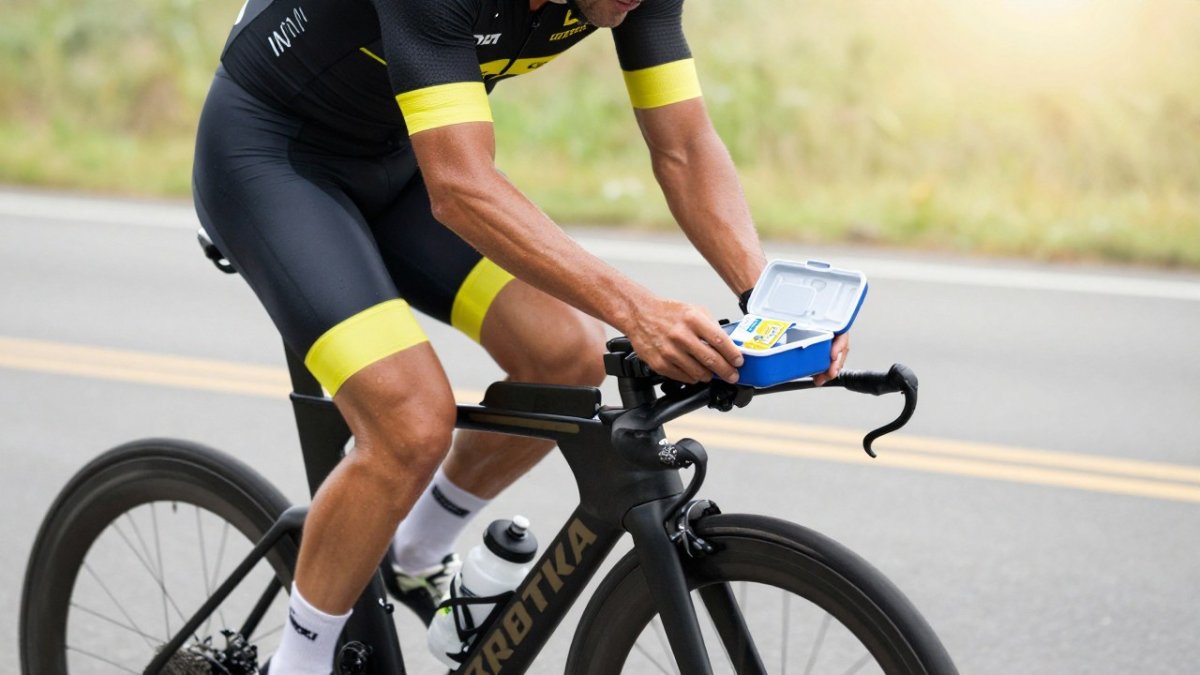
Split your intake accordingly:
- Swim: little to none; focus on pre-race fueling
- Bike: the bulk of your carbs, often 60-90 g/h
- Run: smaller, frequent doses, often 30-60 g/h
On the bike, use a carb-rich drink plus gels or chews. On the run, favor gels and chews you can take at aid stations. Practice grabbing and opening them while moving.
Fueling Around the Swim
The swim is not a fueling opportunity, but it is a fueling decision. You cannot eat in the water, and most athletes should not try. The practical move is to finish your pre-race carbohydrate, typically a gel or a small bottle of sports drink in the 30-60 minutes before the start, and then treat the swim as a bridge to the bike. If your race starts early and your last meal was hours before, a gel in transition before the swim gun is a reasonable bridge; if you ate close to the start, skip it.
Bike-Leg Schedule: Turning Grams Per Hour Into Products
The bike is where you execute the bulk of your plan. A worked example for a 70.3 athlete targeting 80 g/h on a 2.5-hour bike leg:
- Hour 1: one bottle of sports drink mixed at roughly 60 g of carbohydrate, plus one gel at 25 g, about 85 g
- Hour 2: one bottle of sports drink at roughly 60 g, plus one gel at 25 g, about 85 g
- Hour 3 (partial): one gel at 25 g in the final 30 minutes to set up the run
That totals roughly 195-220 g across the bike, or about 80 g/h. The exact product grams depend on your labels, so read them and count every source. Count the drink mix, it is the most commonly forgotten carbohydrate source, and double-counting it against gels is the most common math error.
For a full-distance athlete targeting 90 g/h on a five-hour bike leg, the same structure scales up: two bottles of mix per hour is often too much fluid, so shift the balance toward gels and chews and use the drink for both fluid and a portion of the carbohydrate. A common pattern is one bottle of mix plus two gels per hour, adjusted to your label math.
Run-Leg Schedule: Smaller, More Frequent Doses
The run is where plans fall apart, because appetite drops and the gut is less forgiving under impact. Aim for 30-60 g/h, taken in small, frequent doses rather than one large feed. A worked example for a 70.3 run at 45 g/h:
- Every 30 minutes: one gel at roughly 22-25 g, taken with water at the aid station
- Alternate aid stations: sip sports drink instead of a gel if your stomach prefers liquid
That is roughly 45 g/h across the run without a single large dose. Practice opening and taking gels while moving, and practice taking them with water rather than a carb-heavy drink, so you are not stacking carbohydrate concentration in your stomach.
Watch out: front-loading the bike and neglecting the run is the biggest error we see. Your run-leg intake needs its own written schedule, not whatever is left over from the bike.
For broader context on executing nutrition across the whole race, read our Triathlon Race Strategy for Busy Athletes: 2026 Guide.
How to Train Your Gut for Endurance Fueling
Gut training is the practice of repeatedly exposing your digestive system to race-level carbohydrate intake so it adapts. It works, and it takes weeks, not days.
Start below your goal and build up. A practical progression:
- Weeks 1-2: 40-50 g/h on long rides
- Weeks 3-4: 60 g/h
- Weeks 5-6: 75 g/h
- Weeks 7-8: your race target
Keep sessions easy while you build. Push intake on hard days only after the plan is proven. Many athletes find that frequency matters as much as amount: small doses every 15-30 minutes beat large doses every hour.
Want an expert conversation on fueling updates and specifics? Listen to the AGE GROUPER FOR LIFE PODCAST.
Troubleshooting Race-Day Carb Intake
Most race-day fueling problems fall into a few predictable buckets. Here is how to spot and fix them.
| Symptom | Likely Cause | Fix |
|---|---|---|
| Stomach sloshing | Intake exceeds absorption | Lower g/h, split doses |
| Nausea late in race | Too many simple sugars, low sodium | Rotate sources, add electrolytes |
| Energy crash | Under-fueling early | Front-load on bike |
| Cramping | Fluid and sodium mismatch | Adjust drink concentration |
| GI distress on run | Too much at once | Smaller, more frequent doses |
If you feel sloshing, stop eating for 15 minutes and sip water. Then resume at a lower rate.
Get Your Fueling Plan Reviewed by a Peak Coaching Coach
Numbers on a page only work if they fit your body and your life. That is where personalized review changes the outcome.
Our coaches are age groupers themselves. We build plans around work travel, family schedules, and the training time you actually have. We also offer endurance testing to anchor your targets in real data.
Review our Coaches to see who fits your goals, or submit a coaching inquiry to get your fueling plan reviewed.
Your carb target is not a guess you make the night before a race. It is a number you build, test, and refine over a season.
Frequently Asked Questions
How many grams of carbs per hour should I take during a triathlon?
Published guidance commonly places long-race intake in a 60-90 gram per hour range, and some athletes can handle up to 90-100 grams per hour, though most do not need that much. Shorter races need less. Your own tolerance, race duration, and intensity decide the number, so start inside the range, practice it in training, and adjust from there rather than copying another athlete's plan.
Should I take more carbs per hour on the bike than on the run?
Most triathletes do. The bike leg is steady and low-impact, which makes eating and drinking easier, so it carries the bulk of your hourly intake. The run leg is where gastrointestinal comfort gets fragile, so many athletes shift to smaller, more frequent servings such as gels or chews. A triathlon bike nutrition plan that front-loads carbohydrate intake also sets up a stronger run.
How do I calculate how many gels or sports drinks I need per hour?
Read the label. Gel and drink carbohydrate content varies by product, so check the label of what you plan to use. If your target is 80 grams per hour, add up the grams from each source you choose. Add up the grams from every source, including chews and bars, and confirm the total matches your hourly fueling target before race day.
What happens if I take too many carbs during a triathlon?
Taking in more carbohydrate than your gut can absorb pulls water into the intestine and can cause bloating, cramping, nausea, and diarrhea. Some athletes can tolerate 90-100 grams per hour, but it is unnecessary for most. If symptoms appear, drop back toward a level you have practiced, spread servings across every 15-30 minutes, and use how to train your gut for endurance fueling principles to raise tolerance gradually.