 how-to
Improving Swimming Technique for Adult Triathletes
Table of Contents
- Start Here: What Adult Triathletes Need Before Changing Technique
- Triathlon Swim Drills for Beginners That Build Real Technique
- Common Swimming Technique Mistakes for Triathletes
- How to Improve Swim Endurance for Triathlon Without Losing Form
- Dryland Training and Mobility for Adult Triathletes
- Pool to Open Water: Sighting, Drafting, and Water Confidence
- Frequently Asked Questions
Last Updated: September 30, 2026
Start Here: What Adult Triathletes Need Before Changing Technique
Most adult triathletes try to fix their stroke by swimming more laps. That rarely works. Improving swimming technique for adult triathletes starts with two things: gear that lets you feel the water, and a baseline you can measure. At Peak Coaching, our coaches are age groupers themselves, so we know the pool time you have is limited.
Before you change anything, get these basics in place.
Gear That Supports Better Technique
You do not need much, but the right tools help.
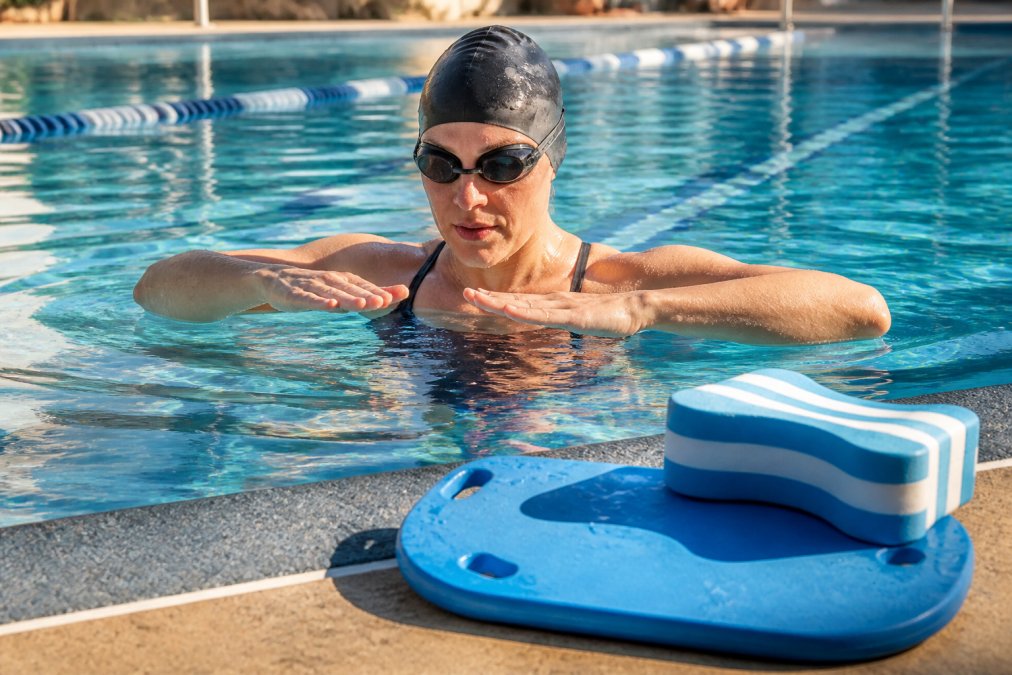
- Fins: They let you hold a straighter leg kick and feel propulsion.
- Pull buoy: It lifts the hips so you can focus on the catch and pull.
- Kickboard: Useful for isolated kick sets, but use it sparingly.
- Tempo trainer: It beeps at a set rhythm for cadence work.
Set a Baseline With Stroke Count and Pace
Count your strokes per length and note your pace for a steady 100. Do this every few weeks. If stroke count drops while pace holds, your stroke efficiency is improving. A USA Triathlon coaching resources guide can help you log this properly.
Triathlon Swim Drills for Beginners That Build Real Technique
The best triathlon swim drills for beginners train one skill at a time. Rotate through a small set across your week instead of grinding out endless laps. Each drill should feel awkward at first. That is the point, if it feels like your normal stroke, you are not changing anything.
The Six Drills, With Dosage and Cues
Do not just run these as a checklist. Each one has a job, a dose, and a cue that tells you it is working.
- 6-1-6 drill, Six kicks on your side, one stroke, then switch. Job: body rotation and hip position. Dose: 4 x 25 yards. Cue: your bottom shoulder should point at the pool floor, and your top hip should break the surface. If you are flat, you are not rotating.
- Sculling, Sweep your hands in figure-eights in front of your chest, no stroke. Job: feel for the water (the catch). Dose: 4 x 25 yards. Cue: you should feel pressure against the palm and forearm, not just the fingertips.
- Fist drill, Swim freestyle with closed fists. Job: forces a high-elbow catch because you cannot cheat with an open hand. Dose: 4 x 25 yards, then 25 yards normal to compare. Cue: your forearm should feel like it is pressing back on the water.
- Catch-up, One hand waits at the front until the other finishes its pull. Job: timing and glide. Dose: 4 x 50 yards. Cue: your lead hand should not start its pull until the other hand passes your head.
- Single-arm, One arm at a time, other arm at your side or extended. Job: exposes a weak pull on either side. Dose: 4 x 25 yards per arm. Cue: the pulling arm should track straight back under your shoulder, not out to the side.
- Side kick, Kick on your side with one arm forward, head down. Job: trains hip position and balance. Dose: 4 x 25 yards per side. Cue: your hips should stay at the surface without you sculling hard to hold them up.
How to Sequence Drills So They Actually Transfer
The mistake most adult triathletes make is doing drills in isolation and then swimming their normal stroke the rest of the session. The drill only helps if you immediately swim a length trying to feel the same thing.
Use a drill-to-swim pairing:
- 25 yards of the drill
- 25 yards of normal freestyle, focusing on the one cue from the drill
- Repeat 4 times
Why These Drills Matter More in Open Water Than in the Pool
In a pool, you have lane lines, walls, and clear water. In a triathlon, you have none of those. The drills above are not just about looking better in the pool, they are about building the specific skills that survive contact with open water:
- 6-1-6 and side kick build the body roll you need to sight without lifting your head.
- Sculling and fist drill build the catch you need to grab water when you are swimming into chop or over another athlete's wake.
- Catch-up builds the timing that keeps you from rushing your stroke when your heart rate spikes at the start.
- Single-arm exposes the asymmetry that causes you to veer off course in open water.
Common Swimming Technique Mistakes for Triathletes
The most common swimming technique mistakes for triathletes come from pool habits that do not survive open water. Fixing them takes awareness more than fitness.
- Crossing the centerline: Your hand enters past your head. It causes shoulder pain and zigzag swimming.
- Lifting the head to breathe: This drops the hips and kills your glide phase.
- Kicking from the knee: A straight leg kick starts at the hip, not the knee.
- Holding your breath: Exhale underwater, inhale fast. Holding air builds panic.
How to Self-Check Without a Coach on Deck
Use a few simple checks. Count strokes per length; a rising count means fading form. Watch your gaze direction: eyes should look down and slightly forward, not at the wall. If your legs feel like anchors, your head position is likely too high.
How to Improve Swim Endurance for Triathlon Without Losing Form
Learning how to improve swim endurance for triathlon is about holding form, not just adding distance. Build volume slowly and keep stroke count steady. When your count climbs, stop and reset.
Try this weekly structure:
- One technique session: Short, drill-heavy, low intensity.
- One endurance session: Longer sets at an easy pace.
- One race-pace session: Short repeats at goal effort.
Dryland Training and Mobility for Adult Triathletes
Dryland training builds the shoulder mobility and core stability that hold your stroke together. Most adult triathletes skip it. That is a mistake, and it is one of the biggest gaps in most technique guides, which treat the pool as the only place technique gets built.
Shoulder Mobility: The Prerequisite for a High-Elbow Catch
If your shoulders are tight, your elbow drops during the catch and you push water down instead of back. That is lost propulsion.
Do these before every swim, 5-10 minutes:
- Banded shoulder rotations, 2 sets of 10 per side. Hold a light band, keep your elbow at 90 degrees, rotate your forearm up and back.
- Wall slides, 2 sets of 10. Stand with your back against a wall, arms in a goalpost position, slide them up and down without losing contact with the wall.
- Thoracic spine rotations, 2 sets of 8 per side. On all fours, thread one arm under your body and rotate, then reach the same arm to the ceiling.
Core Stability: What Holds Your Hips Up
Your core is what keeps your hips at the surface when your legs get tired. Without it, your hips drop, your drag increases, and your stroke count climbs.
Do these 2-3 times per week, 10 minutes:
- Front plank, 3 sets of 30-45 seconds. Keep your hips level; do not let them sag.
- Side plank, 3 sets of 20-30 seconds per side. This is the one that mimics the rotation control you need in freestyle.
- Dead bug, 3 sets of 10 per side. Lie on your back, extend opposite arm and leg while keeping your lower back pressed to the floor.
- Bird dog, 3 sets of 10 per side. On all fours, extend opposite arm and leg, hold for 2 seconds.
Hip and Ankle Range: The Forgotten Piece
Your kick starts at the hip, not the knee. If your hip flexors are tight, your kick becomes a knee-driven flutter that does not propel you. If your ankles are stiff, your feet act like brakes instead of fins.
- Hip flexor stretch, 2 sets of 30 seconds per side. Half-kneeling position, tuck your pelvis and lean forward.
- Ankle rocks, 2 sets of 15 per side. Kneel with toes tucked, rock forward over your toes.
- Standing calf stretch, 2 sets of 30 seconds per side.
A Simple Weekly Dryland Schedule
You do not need a gym. You need consistency.
- Before every swim: 5 minutes of shoulder mobility (banded rotations, wall slides).
- Two days per week: 10 minutes of core work (plank, side plank, dead bug, bird dog).
- Two days per week: 5 minutes of hip and ankle work (hip flexor stretch, ankle rocks, calf stretch).
If you are time-crunched, stack the core and hip work into one 15-minute session twice a week. The goal is not to get stronger in the gym, it is to hold your stroke position longer in the water.
Pool to Open Water: Sighting, Drafting, and Water Confidence
The pool-to-open-water transition trips up more triathletes than fitness does. There are no lane lines, no walls, and no clear water. Practice sighting by lifting your eyes every six to eight strokes, keeping your head low. Drafting behind another swimmer saves energy, so learn to sit on their feet or hip (pubmed.ncbi.nlm.nih.gov).
Frequently Asked Questions
How can I improve my swim technique for a triathlon?
Focus on three things: body position, catch and pull, and breathing rhythm. Adult triathletes typically see the biggest gains from fixing hip position and learning bilateral breathing. Add two drill-focused sessions per week, keep one session for endurance, and track stroke count per length. When stroke count drops at the same pace, your technique is improving. A coach who reviews video can speed up this process, but self-checks with a poolside camera work well too.
What are the most effective swim drills for adult beginners?
Start with four drills: sculling to feel the water, the 6-1-6 drill for body rotation, catch-up freestyle for glide and timing, and single-arm freestyle for high elbow recovery. Do 4x50 of each as part of a warm-up or technique block. Keep the effort easy so you can hold form. Rotate the drill set every few weeks so you do not plateau. These four cover the fundamentals that most adult-onset swimmers miss.
How often should adult triathletes swim per week to see improvement?
Two to three sessions per week is the practical range for busy age groupers. Two sessions maintain technique; three drive real gains. If you can only swim twice, make one session drill-heavy and one endurance-focused. Consistency matters more than volume. A 45-minute focused session twice a week beats one long session that leaves you too tired to hold form. Pair pool work with dryland shoulder mobility to reduce injury risk.
What is the best way to improve swim endurance without sacrificing form?
Build endurance in small blocks and stop the set when form breaks down. Try sets like 6x100 with 20 seconds rest, holding the same stroke count on the last rep as the first. If stroke count climbs, the set is too long or too fast. Add 5 to 10 percent to your weekly volume every few weeks, and include one longer continuous swim every other week. Taper volume before races so you arrive fresh.
The hardest part of improving your swim is knowing what to fix first. Peak Coaching pairs you with coaches who are age groupers themselves, so they understand a full-time job and family schedule. Our multisport coaching, endurance testing, and training camps give you expert guidance built around real life. Get Started with Peak Coaching and swim with a stroke you can trust.