 ultimate-guide
Triathlon Race Strategy for Busy Athletes: 2026 Guide
Table of Contents
- How Busy Athletes Build a Triathlon Race Strategy That Fits Real Life
- Triathlon Race Pacing Strategy: Effort Over Ego
- Triathlon Fueling Strategy: Simple Plans by Race Distance
- Triathlon Transition Practice: Free Speed You Already Own
- Triathlon Race-Day Checklist and Race-Week Scheduling for Working Athletes
- When Training Time Shrinks: Decision Rules for Adjusting Your Triathlon Race Strategy
- Recovery After the Finish Line
- Conclusion: Race the Race You Trained For
- Frequently Asked Questions
Last Updated: October 15, 2026
How Busy Athletes Build a Triathlon Race Strategy That Fits Real Life
Most triathlon race strategy advice assumes you have 15 hours a week to train. You don't. And that's exactly why this guide from Peak Coaching starts somewhere different: with the hours you actually have, not the hours a generic plan demands.
A triathlon race strategy is the plan that connects your available training time to how you'll pace, fuel, and execute on race day. For busy athletes juggling work and family, the best strategy is built backward from realistic weekly hours, not copied from a pro's schedule. The USA Triathlon rules and athlete resources confirm that age-group racing rewards smart execution over raw volume, and that's the entire premise here.
Below, we'll show you exactly how to build a plan around your real calendar, with pacing targets, fueling rules, and decision points for the weeks when everything falls apart.
Start With Your Available Hours, Not a Generic Plan
Count your realistic weekly training hours first, then pick a race distance that fits them. A common mistake is signing up for a 70.3 or Ironman before checking whether the training load fits your life. Sprint and Olympic distances can be trained well on far fewer hours than a long-course event.
Write down three numbers: total hours you can train per week, your longest available single session, and how many days you can train. Then match them to a distance:
| Weekly Hours | Realistic Distance | Long Ride | Long Run |
|---|---|---|---|
| 5-7 | Sprint triathlon | 60-75 min | 40-50 min |
| 7-10 | Olympic distance | 90-120 min | 60-75 min |
| 10-14 | 70.3 | 2.5-3.5 hrs | 75-90 min |
Triathlon Race Pacing Strategy: Effort Over Ego
The single biggest race-day error is going out too hard on the swim and bike, then watching the run fall apart. Pacing by effort and heart rate, not by what the athlete next to you is doing, is what keeps your race together.
Anchor Pacing to Three Numbers You Already Have
You do not need a lab test to pace well. You need three reference points you can find in training:
- Functional threshold heart rate (FTHR), your average heart rate over a hard, steady 20-minute effort, multiplied by 0.95. Most age-groupers land somewhere in the 160-175 bpm range for that number, but use your own.
- Threshold pace or power, the pace or wattage you could hold for about an hour all-out. On the bike, that is your FTP; on the run, it is roughly your 10K pace.
- Rate of perceived exertion (RPE) on a 1-10 scale, the backstop for when heat, hills, or nerves push your heart rate above what your fitness justifies.
From those, the working zones for race day are simple: swim at RPE 6-7, bike at 80-85% of threshold, run the first half at 90-95% of threshold pace and let it drift up only if you feel strong.
Pacing Targets by Distance
| Distance | Swim | Bike | Run |
|---|---|---|---|
| Sprint | Hard but controlled, RPE 8 | At or just below threshold | Threshold pace, hold to the line |
| Olympic | Steady, RPE 7 | 85-90% of threshold | Just below threshold, negative split if possible |
| 70.3 | Easy, RPE 6, no surges | 80-85% of threshold | 15-30 sec/mile slower than open half-marathon pace for the first 5K |
| 140.6 | Very easy, RPE 5-6 | 70-75% of threshold | 30-60 sec/mile slower than open marathon pace early |
The bike leg is where busy athletes lose races. Ride 5-10% easier than you think you should, and you'll pass people on the run instead of being passed.
Course-Specific Adjustments
Generic pacing advice breaks the moment the course stops being flat. Use these rules:
- Hills on the bike: cap your effort on climbs at roughly 90% of threshold and let your power drop 10-15% on descents. Chasing a steady number up a hill is how you blow up at mile 40.
- Hills on the run: shorten your stride and hold effort constant rather than pace. Walking the steepest 20-30 seconds of a climb often costs less total time than running it and recovering afterward.
- Heat above roughly 80°F: drop your target effort by 5-10% and add 10-15 bpm to your expected heart rate. Your heart rate will run high regardless of pace, so pace by RPE, not by the number on your wrist.
Contingency Rules for When the Race Goes Sideways
- Goggles kicked off or swamped: stop, reseat them, and restart. Thirty seconds of composure beats 20 minutes of panic breathing.
- Mechanical on the bike: decide in advance whether you can fix it in under three minutes. If not, ride it in and save your run.
- Missed a bottle at an aid station: do not sprint back. Take the next one and drink a little more there.
Triathlon Fueling Strategy: Simple Plans by Race Distance
Fueling is the most commonly undertrained part of race day. Practice your nutrition on long training sessions, not for the first time in a race.
For a sprint, water and a small gel before the start is usually enough. The American College of Sports Medicine position stands on exercise nutrition explain why practicing intake matters more than the exact product you choose.
Never test new fuel, new shoes, or a new saddle position on race day. The consequence is stomach distress or injury at the worst possible moment, and no time goal is worth it.
Triathlon Transition Practice: Free Speed You Already Own
Transition is the cheapest speed in the sport. You don't need more fitness to save minutes here, just repetition. Set up a mock transition in your driveway or a parking lot and rehearse it weekly.
Lay out your gear in race order, practice the wetsuit strip, mount and dismount the bike, and rehearse racking and shoe changes. Ten minutes of practice a week can save you real time on race day, and it costs you nothing in training load.
Triathlon Race-Day Checklist and Race-Week Scheduling for Working Athletes
Race week is not the time to cram. Reduce training volume, protect sleep, and lock in logistics early so race morning is boring. This is the section most guides skip, they tell you to taper and then leave you to figure out the rest. Here is the whole week, hour by hour where it matters.
Race-Week Schedule Around a Full-Time Job
- Sunday (7 days out): final long-ish session, then taper begins. Do not add anything after this.
- Monday: 30-40 minute easy swim or spin. Keep it short enough that you finish before dinner.
- Tuesday: 20-30 minute easy run with 4 x 30-second pickups. Stay sharp, not tired.
If packet pickup is only available Saturday, treat that as your Saturday task and move the rehearsal to Friday.
Gear Checklist by Bag
Split your gear into three bags so nothing is buried:
Swim bag: wetsuit or swimskin, goggles plus a spare pair, swim cap, body glide, timing chip, earplugs if you use them.
Bike bag: helmet, cycling shoes, socks, sunglasses, race belt with number, nutrition (gels, chews, bars), two bottles, spare tube, tire levers, CO2 inflator or mini-pump, multi-tool, chain lube wipe.
Run bag: running shoes, visor or cap, race belt, extra gels, salt tabs if you use them, small towel.
Transition towel and extras: a bright towel to mark your spot, a small bucket or bag for wet gear, sunscreen, and a plastic bag for a wet wetsuit.
Transition Setup in Race Order
Set up so you touch each item once, in the order you need it:
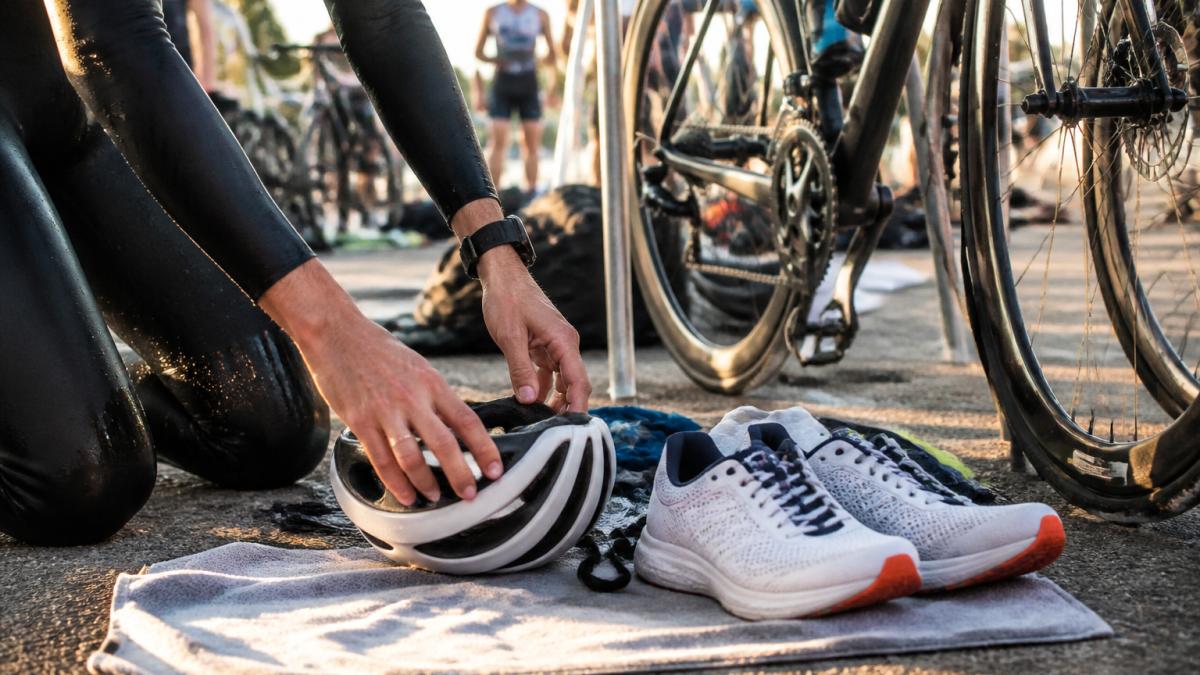
- Bike racked by the saddle or the bars, per race rules, with your helmet on the bars and sunglasses inside it.
- Shoes clipped to the pedals or set just behind the rear wheel, depending on whether you plan a flying mount.
- Run shoes on the towel, heels toward you, with socks rolled inside if you wear them.
- Race belt with number on top of the run shoes.
- Nutrition within reach of the bike, not buried in a bag.
Walk the transition flow once, swim entry to bike rack, bike rack to mount line, dismount line to rack, rack to run exit. Knowing the path saves more time than any gear trick.
Race-Morning Timeline
Work backward from your wave start:
- 3 hours before: wake, eat your rehearsed breakfast, sip fluids.
- 2 hours before: arrive at the venue, park, and walk the transition area.
- 90 minutes before: set up transition, check tire pressure, and confirm your bike is in the right gear for the mount.
Race week is logistics, not fitness. Pack by bag, set up transition in race order, and work backward from your wave start, the athletes who look calm on race morning are the ones who did this on Wednesday.
When Training Time Shrinks: Decision Rules for Adjusting Your Triathlon Race Strategy
Life happens. When your week collapses, use these rules instead of abandoning the plan.
If you lose one session, skip it and move on. If you lose a full week, drop the intensity first and keep one long session. If you lose two or more weeks, reset your race expectations and shift to a shorter distance or a "finish strong" goal. Consistency beats heroics every time, and CDC guidance on physical activity supports keeping regular movement even in reduced doses.
When time shrinks, protect frequency and the long session, cut intensity and volume, and adjust your race goal rather than your commitment.
Recovery After the Finish Line
Recovery is part of the plan, not a break from it. Take at least a few easy days after a race, then a full off-season block of low-structure training before your next build phase. Sleep, hydration, and easy movement do more for your next race than any hard session you squeeze in while exhausted.
Conclusion: Race the Race You Trained For
The hardest part of a triathlon race strategy for busy athletes isn't the training, it's accepting the race your real life allows and executing it brilliantly. At Peak Coaching, our coaches are age-groupers themselves, so we build plans around your actual calendar and offer endurance testing to set your pacing zones. Get started with Peak Coaching and race the race you actually trained for.
Frequently Asked Questions
How should busy athletes pace a triathlon?
Start the swim at an effort you could hold for a longer distance, since going out too hard raises heart rate and ruins the bike. On the bike, aim for a steady effort rather than chasing speed on every hill. Save your hardest running for the final third of the run. A triathlon race pacing strategy built on even effort, not even splits, keeps you moving forward when training hours are limited.
How can I prepare for race day when I have limited training time?
Prioritize race-specific work over volume. One weekly brick session, one threshold swim, and one tempo run cover most of what race day demands. Practice your transition setup at least twice before race week. Write a triathlon race-day checklist and pack your bag two nights early. Athletes with 8 to 10 training hours per week can finish strong at sprint and Olympic distances with this approach.
What should I eat the day before a triathlon?
Keep it familiar. Eat normal meals with a slight emphasis on carbohydrates, and avoid high-fiber, fried, or spicy foods that can upset your stomach. Drink water steadily through the day rather than forcing large amounts at once. Your triathlon fueling strategy for race morning should already be tested in training, so the day before is about topping off glycogen, not trying anything new.
How do I practice triathlon transitions efficiently?
Set up your gear exactly as you will on race day, then rehearse the full sequence: exit the swim, strip the wetsuit, put on helmet and shoes, mount the bike, then dismount and switch to running shoes. Two or three 20-minute sessions cover the basics. Lay items in the order you touch them. Small details, like elastic laces and a race belt, save seconds that add up.
How can I balance triathlon training with a full-time job?
Schedule workouts like meetings, not like spare-time activities. Most busy athletes do well with three swims, three bikes, and three runs per week, with one session per sport being high intensity. Keep one full rest day. When work travel hits, swap in a hotel-gym bike or a pool session. A triathlon race strategy for busy athletes works because the plan bends around your week, not the other way around.
Can the average person do a sprint triathlon?
Yes. A sprint triathlon typically covers a 750-meter swim, a 20-kilometer bike, and a 5-kilometer run. Most people with a base level of fitness can finish one in 8 to 12 weeks of consistent training. The swim is usually the biggest hurdle, so prioritize pool time early. Sprint distance is the best entry point before moving up to Olympic or 70.3 racing.
Why is drafting not allowed in triathlon?
Age-group triathlons are individual efforts, so drafting behind another cyclist is banned to keep the race fair. Rules require riders to keep a set distance behind the bike ahead, usually around 12 meters in most age-group races. If you get passed, drop back before re-passing. Violations lead to penalties or disqualification, so know the rule before race day.