 ultimate-guide
Ironman Nutrition Plan: Training to Race Day
Table of Contents
- Why Ironman Nutrition Planning Matters
- Building Your Training-Period Nutrition Foundation
- How to Calculate Sweat Rate for Triathletes
- Preventing Gastrointestinal Distress in Ironman
- Ironman Race Day Nutrition Strategy: Leg by Leg
- Recovery Nutrition After Training and Race
- Individualizing Your Plan: Worked Examples
- Frequently Asked Questions
Last Updated: October 9, 2026
Why Ironman Nutrition Planning Matters
The 140.6-mile race depletes glycogen, disrupts fluid balance, and stresses digestion.
The gap between finishers and strugglers isn't always fitness, it's fueling strategy. Those who test fueling in training execute on race day.
This guide covers building an ironman nutrition plan across the training cycle: calculating needs, identifying gut tolerance, and executing a leg-by-leg race strategy.
Building Your Training-Period Nutrition Foundation
Most athletes focus only on race day, but the weeks leading up to Ironman demand consistent fueling that supports adaptation and prevents under-fueling. Use every long session to practice race-day fueling.
A complete plan maps daily carbohydrate, protein, fluid, and sodium to your training phase, adjusted to your race calendar.
Base Phase (12-20 Weeks Out)
Volume is moderate, intensity low. Priority: build aerobic capacity and fueling habits.
- Daily carbohydrate: 3-5 g/kg on training days, 2-3 g/kg on rest days. A 160-pound (72.6 kg) athlete targets roughly 218-363 g on training days.
- Daily protein: 1.4-1.8 g/kg to support tissue repair and adaptation.
- During long sessions (90+ minutes): Start at 30-45 g carbohydrate per hour. Test products, flavors, and formats (drink, gel, chews, real food) with low risk.
Build Phase (8-12 Weeks Out)
Volume and intensity rise, with longer rides, runs, and back-to-back sessions.
- Daily carbohydrate: 4-6 g/kg on hard or long days, 3-4 g/kg on easy days. A 160-pound athlete targets roughly 290-436 g on hard days.
- During long sessions: Push carbohydrate to 60-75 g per hour. Use glucose and fructose (often 2:1), they use separate intestinal transporters, increasing total absorption.
- Protein: 1.6-2.0 g/kg, spread across 3-5 meals.
Peak Phase (3-8 Weeks Out)
Volume peaks and race-specific intensity appears. Nutrition becomes rehearsal.
- Daily carbohydrate: 5-7 g/kg on key sessions, 3-4 g/kg on recovery days.
- During long sessions: Target 75-90 g carbohydrate per hour if your gut tolerates it, the range most Ironman athletes aim for on race day.
- Simulation sessions: Do at least two full race-fueling rehearsals: same products, timing, fluid, sodium, and pre-session meal.
Taper Phase (Final 1-3 Weeks)
Training volume drops, but nutrition doesn't. Many athletes accidentally under-fuel here.
- Daily carbohydrate: Keep intake high relative to the reduced load, 4-6 g/kg, to top off glycogen. Some use a 2-3 day carb load of 8-10 g/kg before race day, but only if practiced in training.
- Protein: 1.6-2.0 g/kg.
- Fiber and fat: Reduce fiber in the final 24-48 hours to lower gut residue. Keep fat moderate; very high fat slows gastric emptying.
Rest and Recovery Days
Rest days aren't "eat whatever" days, they're when your body repairs tissue and restocks glycogen.
- Carbohydrate: 2-3 g/kg. Enough to support recovery without excess.
- Protein: 1.6-2.0 g/kg. Spread across meals.
- Fluid: Drink to thirst plus a glass with each meal; pale-straw urine is a reasonable target.
Calorie and Macronutrient Targets for Long Training Sessions
Calorie needs scale with duration and intensity, a three-hour ride burns far more than a one-hour run.
For sessions over 90 minutes, consume carbohydrates throughout. The amount depends on body weight, intensity, and training phase; heavier athletes and higher intensities require more per hour.
Protein matters less during training but supports recovery afterward. Most athletes benefit from a post-training meal with carbohydrates and protein within 30-60 minutes.
Carbohydrate Intake During Long-Distance Training
Carbohydrates are your primary fuel during endurance exercise. Unlike fat, they deplete, and when they're gone, performance drops sharply.
Your gut has limits, though, and exceeding them causes gastrointestinal distress. Start conservatively and increase gradually as your gut adapts, this is gut training. Most athletes tolerate more carbohydrates late in their training cycle than early on.
How to Calculate Sweat Rate for Triathletes
Sweat rate determines how much fluid you need, and it varies with body size, genetics, fitness, and conditions. Calculating yours removes the guesswork.
Step-by-Step Sweat Rate Calculation
The process takes one training session.
Step 1: Weigh yourself nude before training. Record this in pounds.
Step 2: Train for exactly one hour at race intensity.
Step 3: Weigh yourself immediately after training, still nude and after toweling off sweat.
Step 4: Calculate the difference. Subtract post-training weight from pre-training weight, this is weight lost in pounds.
This number is your baseline sweat rate for that specific condition.
Adjusting for Heat, Humidity, and Intensity
Your calculated rate applies only to the conditions you tested in. Heat and humidity increase sweat rate significantly, so a cool-weather test underestimates hot race-day needs.
If you test in mild conditions, increase fluid intake 10-20% on warmer days.
Preventing Gastrointestinal Distress in Ironman
Gastrointestinal problems are among the most common reasons athletes slow down or drop out of Ironman races. High intensity, dehydration, and a heavy fuel load stress the digestive system, prevention starts in training. Maintaining electrolyte balance through targeted mineral supplements for recovery helps mitigate these physiological stressors and ensures the gut remains resilient throughout the grueling hours of competition.
Gut Training and Product Testing
Your gut adapts to fueling like your muscles adapt to training. Begin gut training early, using the exact products you plan to race with, sports drinks, gels, or solid food.
Start small and increase gradually. A common mistake is waiting until late training to practice race fueling, leaving no time to troubleshoot.
Common Triggers and Troubleshooting
High fat and high fiber slow digestion, so avoid them in race nutrition and limit them before training sessions.
Dehydration worsens GI distress, too little fluid causes nausea and cramping, too much causes bloating. Your sweat rate calculation guides the right amount.
Consuming too many carbohydrates too quickly overwhelms your gut. If you get nauseous or cramp during training, reduce your hourly intake and increase gradually over subsequent sessions.
Ironman Race Day Nutrition Strategy: Leg by Leg
Race-day nutrition differs from training because you can't stop to digest or adjust. Everything must be planned and practiced. The timeline below is a template, adjust quantities to your body size, sweat rate, and gut tolerance, and rehearse the sequence in training.
Pre-Race Meal and Swim Leg Fueling
Eat your final meal 2-3 hours before the start: familiar, easily digestible, with carbohydrates and moderate protein. Avoid high fat and high fiber, toast with peanut butter and banana, oatmeal with honey, or a bagel with jam all work.
- 3 hours before: 1-2 g/kg carbohydrate (e.g., 80-160 g for a 160-pound athlete) plus 20-30 g protein. Example: 2 cups cooked oatmeal with 1 banana, 1 tbsp honey, and 2 eggs.
- 1 hour before: 15-30 g carbohydrate if tolerated, plus 8-16 oz fluid with 300-500 mg sodium. Example: 1 gel with water.
- 15 minutes before: Optional small gel or sip of sports drink. Don't try anything new.
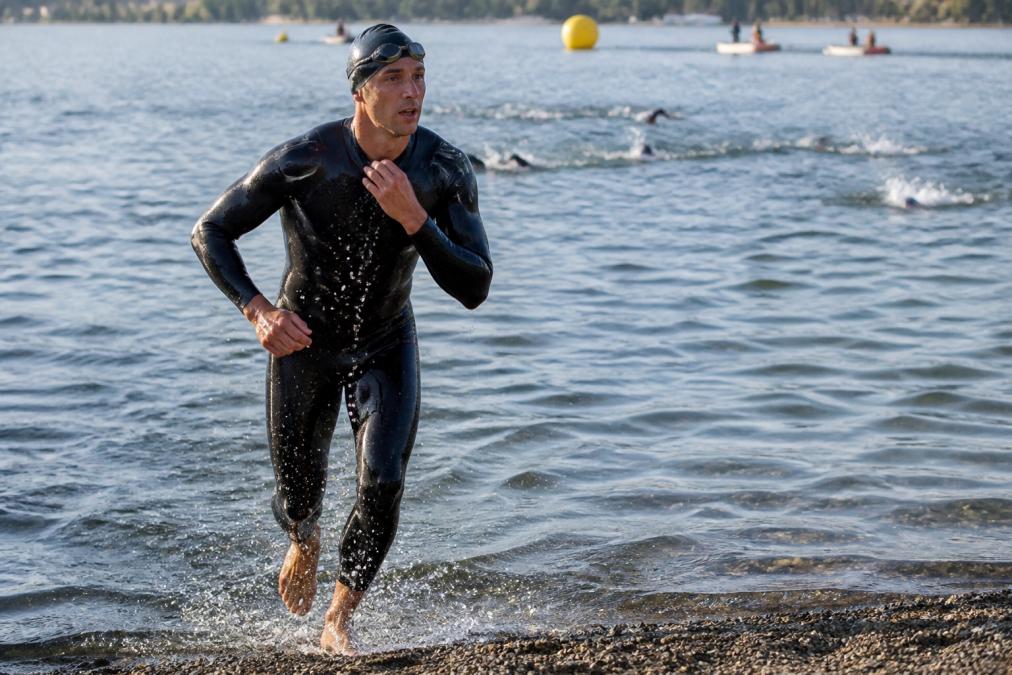
You won't consume calories during the swim, which lasts 45 minutes to over an hour. Stay calm, execute your plan, and begin fueling on the bike.
Bike Leg Fueling Strategy
Begin fueling within the first 20-30 minutes.
Drink according to your sweat rate, adjusting slightly for temperature and how you feel.
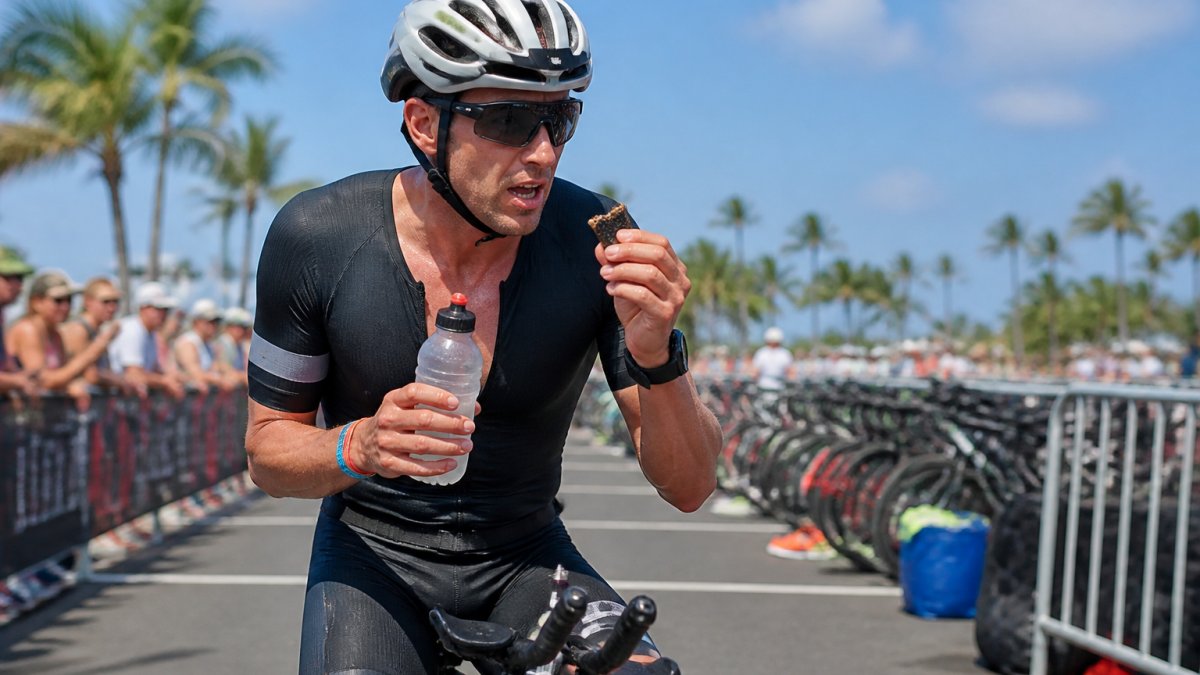
Sample bike timeline for a 6-hour bike leg (160-pound athlete, 75 g carbohydrate/hour target):
| Time | Action | Carbohydrate | Fluid | Sodium |
|---|---|---|---|---|
| 0:00-0:20 | Settle in, sip water | 0 g | 8 oz | 0 mg |
| 0:20 | First gel + water | 25 g | 8 oz | 100 mg |
| 0:45 | Sports drink | 30 g | 16 oz | 200 mg |
| 1:15 | Half energy bar | 20 g | 8 oz | 100 mg |
| 1:45 | Gel | 25 g | 8 oz | 100 mg |
| 2:15 | Sports drink | 30 g | 16 oz | 200 mg |
| 2:45 | Half energy bar | 20 g | 8 oz | 100 mg |
| 3:15 | Gel | 25 g | 8 oz | 100 mg |
| 3:45 | Sports drink | 30 g | 16 oz | 200 mg |
| 4:15 | Gel | 25 g | 8 oz | 100 mg |
| 4:45 | Sports drink | 30 g | 16 oz | 200 mg |
| 5:15 | Gel | 25 g | 8 oz | 100 mg |
| 5:45 | Sip water, prepare for run | 0 g | 8 oz | 0 mg |
Totals: ~75 g carbohydrate/hour, ~24-32 oz fluid/hour, ~600-800 mg sodium/hour.
Backup options: If you drop a bottle or gel, use on-course sports drink and bananas.
Run Leg Fueling and Final Energy Management
Reduce carbohydrate intake to roughly 50-75% of your bike hourly rate, enough energy without overwhelming your stomach.
Walk through aid stations if needed.
Sample run timeline for a 4-hour run (same athlete, 45-55 g carbohydrate/hour target):
| Time | Action | Carbohydrate | Fluid | Sodium |
|---|---|---|---|---|
| 0:00-0:15 | Settle, sip water | 0 g | 4 oz | 0 mg |
| 0:15 | Gel + water | 25 g | 4 oz | 100 mg |
| 0:45 | Sports drink at aid station | 20 g | 8 oz | 150 mg |
| 1:15 | Gel | 25 g | 4 oz | 100 mg |
| 1:45 | Sports drink | 20 g | 8 oz | 150 mg |
| 2:15 | Gel | 25 g | 4 oz | 100 mg |
| 2:45 | Sports drink | 20 g | 8 oz | 150 mg |
| 3:15 | Gel | 25 g | 4 oz | 100 mg |
| 3:45 | Sports drink | 20 g | 8 oz | 150 mg |
Totals: ~50 g carbohydrate/hour, ~16-24 oz fluid/hour, ~400-600 mg sodium/hour.
Backup options: If nauseous, switch to cola and pretzels at aid stations.
Recovery Nutrition After Training and Race
Recovery nutrition begins immediately after finishing, the first 30-60 minutes is when muscles are most responsive to carbohydrates and protein.
Consume a meal or snack with both within this window. A practical target is 1 g carbohydrate and 0.25-0.4 g protein per kilogram of body weight.
Rehydrate over the next few hours: drink 150% of your weight loss over 4-6 hours to account for continued sweat and urine losses.
Individualizing Your Plan: Worked Examples
Generic advice doesn't account for your body or schedule.
Example 1: Athlete weighing 160 pounds, training 10 hours per week
Long sessions include a 3-hour bike and 2-hour run weekly.
This lighter athlete needs fewer calories but may have lower carbohydrate tolerance.
Sweat rate is likely lower, so fluid intake might be 0.7-0.9 liters per hour.
Building an ironman nutrition plan requires testing, adjustment, and honesty about what your body tolerates. At Peak Coaching, we help age group athletes design individualized fueling strategies for their physiology, schedule, and race goals.
Frequently Asked Questions
How many calories should I consume per hour during an Ironman?
Most endurance athletes aim for 200-300 calories per hour during the bike leg and 100-200 calories per hour during the run leg. Your exact target depends on body weight, fitness level, and gut tolerance. Start by calculating your needs based on training data: multiply your body weight in pounds by 1.5 to 2 for bike fueling, and 0.5 to 1 for running. Test these targets in long training sessions before race day to avoid gastrointestinal distress.
What is the best way to practice nutrition during long training rides?
Use your long training sessions to test the exact products, timing, and volumes you plan to use on race day. Start with small amounts of carbohydrates and electrolytes early in the ride, then increase gradually as your gut adapts. Practice fueling every 45-60 minutes on the bike. Keep detailed notes on what you ate, how much, when you consumed it, and how you felt. This gut training prevents race-day surprises and builds confidence in your fueling strategy.
How do I prevent GI distress during an Ironman race?
Prevention starts with gut training during your training period. Use only products you've tested extensively in workouts. Avoid high-fiber foods, excess fat, and unfamiliar foods the day before and day of the race. During the race, spread carbohydrate intake across multiple sources (sports drink, gels, solid foods) rather than consuming large amounts at once. Stay hydrated without overdrinking, and match your fueling rate to your actual sweat rate. If distress occurs, reduce solid food intake and increase fluid carbohydrates temporarily.
How do I calculate my sweat rate for hydration planning?
Weigh yourself naked before a 1-hour training session in conditions similar to race day. Drink a measured amount of fluid during the hour. Weigh yourself again immediately after. Sweat rate equals: (pre-weight minus post-weight in pounds plus fluid consumed in ounces) divided by exercise duration in hours. For example, if you lost 2 pounds and drank 16 ounces over 1 hour, your sweat rate is approximately 48 ounces per hour. Adjust this target based on heat, humidity, and intensity during your actual race conditions.
What should I eat the night before an Ironman?
Eat a familiar, well-tolerated meal with moderate carbohydrates, moderate protein, and minimal fat and fiber. Examples include pasta with lean meat and olive oil, rice with grilled chicken, or a sandwich with turkey and cheese. Aim for 500-800 calories depending on your body size. Avoid trying new foods or restaurants. Drink fluids consistently throughout the day and evening, but taper fluid intake 2-3 hours before bed to avoid sleep disruption. Eat a light breakfast 2-3 hours before the race start.
What are the best sources of carbohydrates for endurance athletes?
During exercise, prioritize easily digestible carbohydrates: sports drinks, energy gels, sports bars, and simple foods like bananas or rice cakes. These break down quickly and provide fast energy without overloading your gut. For pre-race and recovery meals, include whole grains, oats, fruit, and starchy vegetables like potatoes. During training, test both liquid and solid carbohydrate sources to find what your stomach tolerates best at race intensity. Individual tolerance varies widely, so experimentation during training is essential.
Can I use real food instead of sports products during an Ironman?
Yes, many athletes use real foods successfully during Ironman races. Options include energy bars, bananas, dates, rice cakes, sandwiches, and potatoes. Real food can be cheaper and more satisfying than commercial products, but it requires thorough gut training during your training period. The key is testing amounts and timing to ensure your stomach tolerates them at race intensity and heat. Combine real food with sports drinks to meet your total carbohydrate and fluid targets, and always have a backup plan if your first choice causes distress.