 how-to
Customizing Triathlon Plans for Busy Parents
Table of Contents
- Assess Your Current Fitness and Available Time
- Build a Triathlon Training Schedule for Working Parents
- Incorporate Time-Efficient Triathlon Workouts
- Handle Disruptions and Missed Workouts
- How to Adjust a Triathlon Training Plan When Life Happens
- Balance Training Load with Recovery and Sleep
- Customize Your Plan by Race Distance and Goals
- Track Progress and Know When to Adjust
- Frequently Asked Questions
Last Updated: October 11, 2026
Assess Your Current Fitness and Available Time
Before customizing triathlon plans for busy parents, honestly evaluate your fitness level, swimming ability, and cycling/running experience. Customizing triathlon plans means matching intensity and volume to your actual capacity, not some idealized version.
Audit your weekly time realistically. Most busy parents have 5-8 hours per week. Write down work hours, family commitments, and non-negotiable time with your kids. This number drives everything else.
Build a Triathlon Training Schedule for Working Parents
Weekly template structure
A working parent's week typically includes one swim, two bike sessions, two run sessions, and one or two recovery days, totaling 6-8 hours depending on intensity.
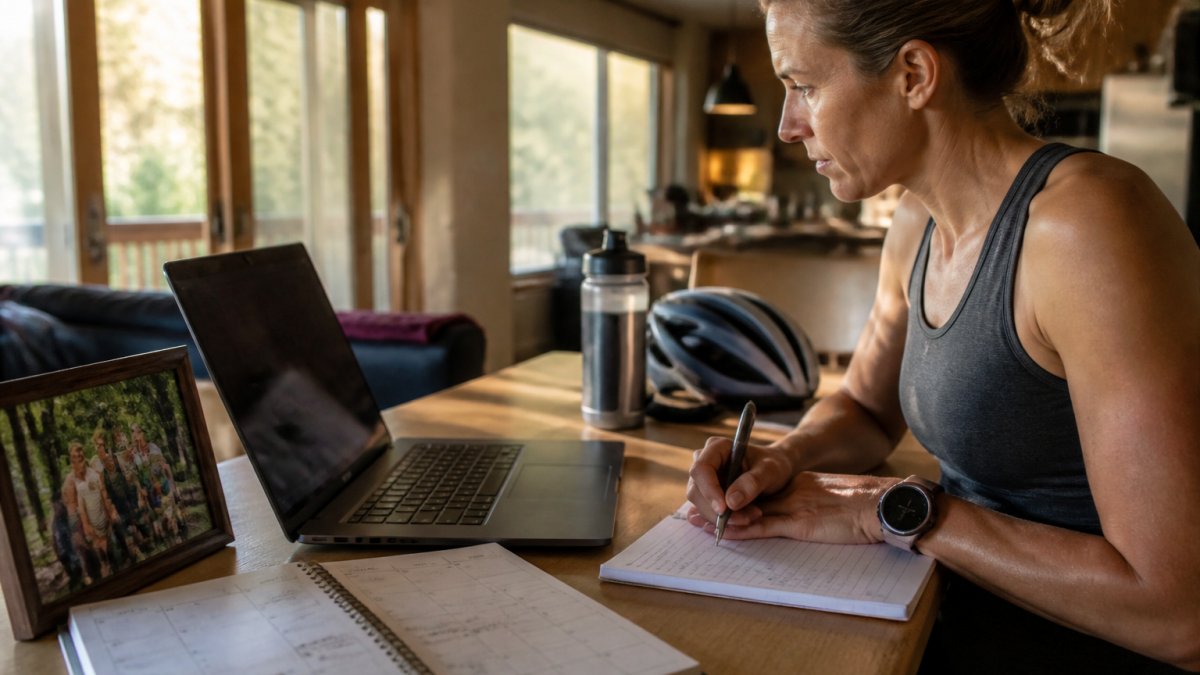
Place your longest session on a day you control, typically Saturday morning (90 minutes to 2 hours). Your second-longest session goes midweek (45-60 minutes).
Shorter sessions fit around work: a 30-minute swim before work or a 20-minute run at lunch. Brick workouts (bike immediately followed by a run) save time and build race-specific fitness.
Placing swim, bike, and run sessions
Never stack hard efforts back-to-back. If you do a hard bike session Tuesday, make Wednesday a recovery run or swim to protect against overtraining.
Swims work well early morning (45 minutes before work). Bikes fit lunch breaks or early evenings. Runs are flexible, early morning or after kids go to bed.
Consistency in timing becomes habit. Your family learns the pattern and your body adapts. Customizing triathlon plans for busy parents means finding the schedule you'll actually follow.
Incorporate Time-Efficient Triathlon Workouts
Short, high-intensity sessions
A 30-minute bike session with 4 x 3-minute intervals delivers more training stimulus than 90 minutes of easy riding. High-intensity interval training (HIIT) compresses fitness gains into shorter time windows.
For busy parents, a brutal 30-minute workout before work delivers real training stimulus. Your body responds to training stress, not duration.
A 2,000-meter swim with 8 x 200 meters at threshold pace (35-40 minutes) builds aerobic power. Running repeats deliver speed work in 30 minutes.
Brick workouts and back-to-back sessions
Brick workouts save time and build race-specific strength. A 45-minute bike followed by a 20-minute run teaches your legs to run hard when fatigued, exactly what happens in a triathlon.
A typical brick: 40 minutes of steady bike work, then 15-20 minutes of moderate running. You get two training sessions in 60 minutes total, plus transition practice.
Back-to-back sessions save time but demand recovery. Use them sparingly, once per week at most, and pair with easier sessions the rest of the week.
Handle Disruptions and Missed Workouts
Life happens. Customizing triathlon plans for busy parents means building flexibility into your plan, not treating missed workouts as failures.
The disruption triage framework
Priority 1: Keep the hard session. If you only have 60 minutes total, do the intervals and skip the easy run.
Priority 2: Shorten, don't skip. If you have 45 minutes instead of 60, cut warm-up and cool-down slightly, but keep the main set intact.
Priority 4: Never catch up by doubling up. One missed workout is a 1% loss over a month.
Common disruption scenarios and responses
Child is sick (you have zero training time for 2-3 days). Accept it. Two missed days in a 12-week block is negligible.
Unexpected time gain (you have an extra hour). Ask: Am I recovered from this week's training? If yes, add one easy session (20-30 minutes).
Illness or fatigue (you feel flat or run-down). Cut easy sessions first. If very fatigued, do intervals at 85% intensity or reduce repeats.
The weekly reality check
Track what you actually complete. Over a month, consistency beats perfection. At week's end, ask: Did I complete one hard session, one longer session, and at least three sessions total? If yes, your week was successful.
How to Adjust a Triathlon Training Plan When Life Happens
Scaling intensity and volume
When life gets busy, reduce volume, not intensity. Cut easy sessions; keep hard ones. Prioritize intensity when time is limited.
If you normally do 8 hours per week but can only manage 5, cut easy sessions from 90 to 45 minutes. Keep interval sessions at full intensity. This preserves fitness while honoring your time constraint.
Volume creep causes burnout. Customizing triathlon plans means staying disciplined about total time, even when you feel like you should do more.
Rescheduling around work travel and family events
Work travel disrupts training. A week with three nights away means fewer training days. Plan for four sessions: one long, two intervals, one recovery.
Family events are non-negotiable. Move your long session to Sunday or Friday, or split it across two days.
You're not failing your plan; you're adapting it to your life. That's what customizing triathlon plans for busy parents means.
| Disruption | Adjustment | Result |
|---|---|---|
| Work travel (3 days) | Reduce from 6 to 4 sessions | Maintain fitness with fewer days |
| Family event | Move long session to adjacent day | Preserve weekly structure |
| Illness/fatigue | Cut easy sessions, keep hard ones | Preserve intensity, reduce volume |
| Unexpected time gain | Add one extra session | Build fitness without overloading |
Balance Training Load with Recovery and Sleep
Training stimulus signals improvement; recovery allows adaptation. Without recovery, you get fatigue and burnout.
For parents, recovery is harder to protect than training time. Your recovery strategy must account for the realities of parenting, not assume ideal conditions.
Sleep as a training variable
Eight hours of sleep is the target for athletes doing moderate to hard training. Most busy parents average 6.5 to 7 hours, a compounding deficit.
If you're sleeping six hours per night, your body cannot fully recover from eight hours of weekly training. You have three options:
- Increase sleep. Often unrealistic for parents of young children.
- Reduce training volume. Train 5-6 hours per week instead of 8-10. Prioritize intensity over volume.
- Reduce training intensity. Keep volume but lower intensity. Least effective but sometimes necessary during high-stress periods.
Most busy parents oscillate between options 2 and 3. During heavy work periods or poor child sleep, reduce volume and intensity slightly. When life settles, increase both.
Track your sleep for two weeks. If consistently below seven hours, your training plan is too ambitious. Adjust downward.
Recognizing overtraining in a parent's life
Overtraining shows as elevated resting heart rate, persistent fatigue, and declining performance (Overtraining Syndrome: A Practical Guide).
If training feels like a burden or you're dreading workouts, your training load is too high for your current recovery capacity.
Other signals: missing sessions due to fatigue (not schedule), elevated resting heart rate, frequent illness, flat performance, or persistent tiredness despite more sleep.
When you see these signs, reduce training volume for 1-2 weeks. Cut weekly hours by 20-30%, keep intensity, reduce session count.
Recovery days and active recovery
One or two complete rest days per week prevents overtraining. A complete rest day means no structured training.
Active recovery days fit easily: a 20-minute easy swim, 30-minute easy bike, or 20-minute walk at conversational pace. Movement without training stress allows repair while keeping you engaged.
Place recovery days strategically: after your hardest week, schedule a complete rest day. After a long session, make the next day easy or off.
Sleep disruption and training adjustment
Parents often face unpredictable sleep disruption. You get five hours of fragmented sleep instead of eight.
On those days, do an easy session or skip training. One missed session after bad sleep is better than pushing through a hard workout on insufficient recovery.
If sleep disruption is chronic, reduce your training plan. You cannot build fitness on five hours of sleep per night.
Recovery nutrition and hydration
Recovery starts immediately after training. Within 30 minutes, eat carbohydrates and protein to replenish muscle glycogen and start protein synthesis.
Stay hydrated throughout the day. If training hard, add electrolytes (sodium) to your water, especially if sweating heavily.
On recovery days, eat normally. Your body needs fuel to repair. Undereating extends fatigue and slows adaptation.
Stress and recovery
Training, work, and parenting are all stressors that stack. When all three are high simultaneously, your body's recovery capacity is exceeded.
During high-stress periods, reduce training volume. A 5-hour training week during a stressful month is better than an 8-hour week that leaves you exhausted.
After the stressful period passes, gradually increase training back to normal over 2-3 weeks.
Customize Your Plan by Race Distance and Goals
Sprint and Olympic distance plans
A sprint triathlon requires 8-12 weeks of training at 5-7 hours per week. Emphasis goes on speed and short intervals.
An Olympic distance needs 12-16 weeks at 7-10 hours per week. The longer distances demand more volume, but intensity can stay moderate.
For sprint distance, prioritize interval work. For Olympic, balance intervals with longer steady-state sessions.
Half-Ironman and Ironman approaches
Half-Ironman training requires 10-14 hours per week for 16-20 weeks. The long bike ride (two hours) and long run (90 minutes) demand weekend time.
Ironman training is 12-16 hours per week for 20-24 weeks. Most busy parents can't sustain this without significant life changes. Consider whether this is the right time.
Ironman training and full-time parenting of young children rarely coexist peacefully. A half-Ironman or multiple sprint/Olympic races might better match your life stage.
Track Progress and Know When to Adjust
Track what you actually do: workout, duration, intensity, and how you felt. Over four weeks, patterns emerge.
Are you missing sessions on certain days? Move that session elsewhere. Constantly fatigued? Cut volume.
Review your plan monthly. Ask: Am I completing 80% of planned sessions? Improving in key areas? Enjoying training?
Customizing triathlon plans for busy parents is ongoing. Your available time, fitness, and goals shift.
Frequently Asked Questions
How can I fit triathlon training into a busy schedule with work and family?
Start by scheduling training sessions like work meetings, non-negotiable blocks on your calendar. Most busy parents succeed with 4-5 workouts per week rather than 6-7, focusing on quality over quantity. Place longer sessions on weekends when childcare is easier to arrange, and use time-efficient workouts like 30-minute runs or bike commutes on weekdays. The key is consistency with fewer sessions rather than sporadic attempts at a full schedule. Many parents find early morning or lunch-hour training works best because evening schedules are unpredictable with kids' activities.
How do you adjust a triathlon training plan when you miss workouts?
Don't try to make up missed sessions, this leads to burnout and injury. Instead, skip that workout and continue with the next scheduled session. If you miss multiple workouts in a week, reduce the intensity of upcoming sessions rather than extending the plan. For example, turn a hard interval workout into a steady-pace session. Track which types of sessions you consistently miss (often long weekend rides for parents), and redesign your plan to use shorter alternatives.
Can you train for a triathlon with only a few hours per week?
Yes, but it depends on your race distance and goals. Sprint and Olympic distance triathlon training can work with 5-7 hours per week. For half-Ironman and Ironman distances, plan for 8-12 hours weekly to build adequate endurance. Busy parents often succeed with shorter distances by using time-efficient workouts: high-intensity intervals, brick sessions combining two sports, and strategic long sessions on weekends. The quality and consistency of your training matters more than total volume, especially if you're new to triathlon or returning after time away.
How should I schedule swim, bike, and run workouts around work and childcare?
Structure your week with one swim per week (often easier to schedule at a set time), two bike sessions, and two runs. Place your longest session on Saturday or Sunday when childcare is manageable. Pair bike and run workouts back-to-back on weekdays to minimize time away from family. Schedule swims early morning or during lunch if your gym offers that option. This approach, one swim, two bikes, two runs, is sustainable for working parents training for sprint or Olympic distance events. Adjust the pattern if you have predictable childcare on certain days.