 how-to
Customize Triathlon Training Plans: 2026 Guide
Table of Contents
- Step 1: Define Your Athlete Profile and Race Goal
- Step 2: Set Weekly Volume and Training Frequency
- Step 3: Choose the Right Triathlon Training Plan Templates
- Step 4: Adjusting Triathlon Training for Busy Schedules
- Step 5: Get Triathlon Training Intensity Distribution Right
- Step 6: How to Balance Swim Bike Run Training Each Week
- Step 7: Use Wearable Data and Recovery Protocols to Fine-Tune
- Common Mistakes When You Customize Triathlon Training Plans
- Frequently Asked Questions
Last Updated: September 28, 2026
Step 1: Define Your Athlete Profile and Race Goal
The best triathlon training plans start with an honest look at who you are, not a generic schedule pulled from a search result. At Peak Coaching, we understand that age group athletes can waste entire seasons on plans built for someone else. Your athlete profile is the raw material every later decision gets built on.
Start with these inputs:
- Race distance and date - sprint, Olympic, 70.3, or Ironman
- Current weekly training hours - be honest, not aspirational
- Sport-by-sport strengths - where you're fast, where you survive
- Limiter sport - the discipline that costs you the most time
- Age and injury history - both shape recovery needs
- Life constraints - work travel, family duties, sleep
This last piece matters more than most guides admit. A plan that ignores your calendar is a plan you'll abandon by week three.
Your race goal drives everything downstream. A finish-line goal needs different volume than a podium goal. Pick one, write it down, and let it filter every choice that follows.
Step 2: Set Weekly Volume and Training Frequency
Weekly volume is the total hours you train across all three sports. Frequency is how many sessions you spread those hours across. Both numbers should reflect your real life, not a template.
A common approach is to build from your current baseline rather than jumping to a target. If you train six hours now, a plan that starts at twelve will break you.
Anchor Volume to Race Distance
Race distance sets a realistic ceiling for peak weekly hours. These ranges reflect what most age group athletes can absorb without breaking down, assuming a 12-20 week build:
| Race Distance | Peak Weekly Hours | Long Ride | Long Run |
|---|---|---|---|
| Sprint | 5-7 | 60-90 min | 30-45 min |
| Olympic | 7-10 | 90-120 min | 45-70 min |
| 70.3 | 10-14 | 2.5-3.5 hr | 75-100 min |
| Ironman | 14-20 | 4-6 hr | 2-2.5 hr |
Convert Hours into Sessions
Frequency matters because adaptation comes from repeated exposure, not one heroic session. A rough guide:
- Swim: 2-3 sessions per week. Frequency beats duration here, technique degrades when you swim long and tired.
- Bike: 3-4 sessions per week, including one long ride and one intensity session.
- Run: 3-4 sessions per week, including one long run. Running is the highest injury-risk sport, so add frequency before you add duration.
- Strength: 1-2 short sessions, ideally on the same day as a hard bike or swim to keep easy days truly easy.
Sequence the Build
Progressive overload still applies. Add volume in small steps, then hold before adding more. The ACSM exercise guidance supports gradual increases to lower injury risk.
A workable pattern for most age groupers:
- Weeks 1-3: Build volume by roughly 5-10 percent per week.
- Week 4: Cut volume by 20-30 percent. Keep intensity, drop duration.
- Weeks 5-7: Resume building from the week-3 level, not the week-4 level.
- Week 8: Another down week, then reassess.
The Frequency Trade-Off
When life forces a choice between more hours and more sessions, choose sessions. Three 45-minute rides build more fitness than one 2-hour ride for most age groupers, because the adaptation stimulus repeats. The exception is the long ride and long run, those serve race-specific endurance and fueling practice, so protect them and cut elsewhere first.
Step 3: Choose the Right Triathlon Training Plan Templates
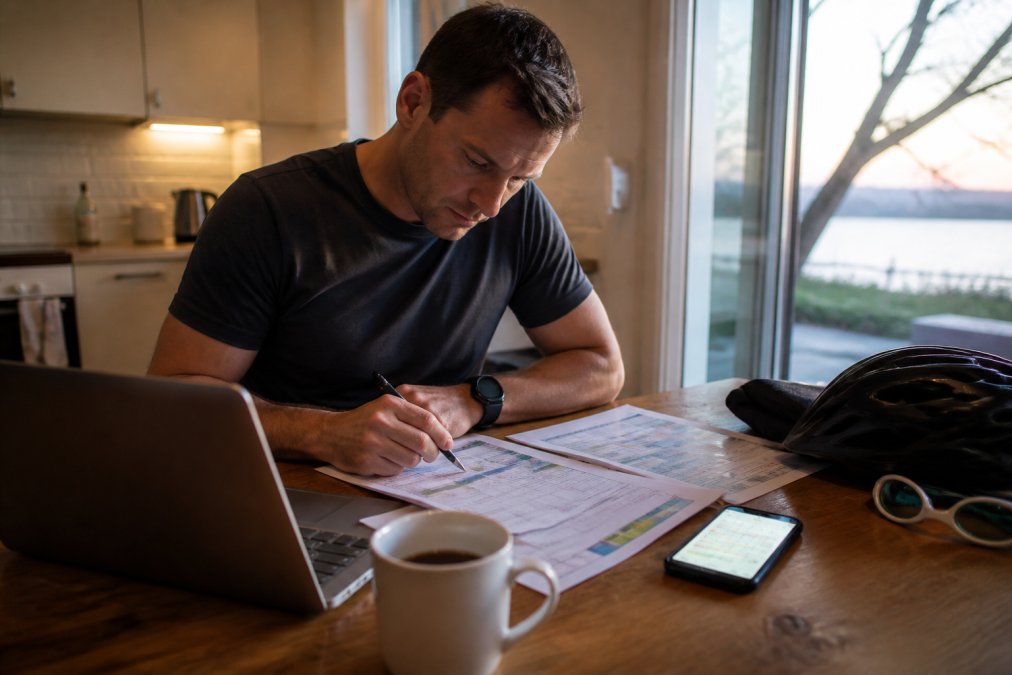
Templates are starting points, not finished products. The right template gives you a sound structure you can edit; the wrong one locks you into someone else's life.
- Does the weekly structure match your available days?
- Does it build periodization into the plan, or just repeat weeks?
- Does it name intensity zones, or leave effort vague?
- Can you edit it without breaking the logic?
Step 4: Adjusting Triathlon Training for Busy Schedules
Adjusting triathlon training for busy schedules is less about finding more hours and more about protecting the hours you have. Most age groupers don't need a bigger week. They need a smarter one.
Try these moves when life compresses your time:
- Move the long ride to the day with the fewest conflicts
- Swap a missed swim for a shorter, higher-quality pool session
- Use brick workouts to combine bike and run in one block
- Cut the lowest-value session first, not the hardest one
- Protect sleep before adding volume
Step 5: Get Triathlon Training Intensity Distribution Right
Most age group athletes train too hard on easy days and too easy on hard days. Getting triathlon training intensity distribution right is the single biggest performance lever for athletes who already train consistently.
Pick a Distribution Model
There is no single correct split. Three models dominate, and the right one depends on your race distance, training age, and how much time you have.
| Model | Easy | Moderate | Hard | Best For |
|---|---|---|---|---|
| Polarized | 75-80% | 5% or less | 15-20% | Time-crunched athletes, short-course racing |
| Pyramidal | 75-80% | 10-15% | 5-10% | Long-course athletes building aerobic base |
| Threshold-focused | 70% | 20% | 10% | Experienced athletes with a strong base |
Set Your Zones Before You Train
Zones are only useful if they are yours. Generic percentages of max heart rate are a starting point, not a finish line. Two field tests cover most athletes:
- Bike: A 20-minute time trial, then take 95 percent of average power as your functional threshold power. Set easy rides at 55-75 percent of FTP, tempo at 76-90 percent, and threshold at 91-105 percent.
- Run: A 30-minute time trial, then take the average pace from the final 20 minutes as your threshold pace. Easy runs sit 60-90 seconds per mile slower than threshold.
- Swim: A 1,000-yard or 1,000-meter time trial, then use that pace as your threshold. Easy sets run 10-15 seconds per 100 slower.
Make Easy Days Actually Easy
The most common failure is easy days run at moderate effort. If you cannot hold a conversation on a bike ride, it is not an easy ride. Heart rate drift, terrain, and group rides all push effort upward without you noticing. Cap easy sessions with a heart rate ceiling and let pace fall where it falls.
Make Hard Days Actually Hard
Functional threshold power and pace zones give you objective targets. Heart rate variability can flag when you're pushing too hard too often, and a rising resting heart rate alongside flat legs is a signal to shift a hard session to easy rather than push through.
Step 6: How to Balance Swim Bike Run Training Each Week
How to balance swim bike run training depends on your limiter and your race distance. There's no universal split, but there is a logic.
A workable weekly shape looks like this:
- Swim: 2-3 sessions, technique-focused
- Bike: 3-4 sessions, including one long ride
- Run: 3-4 sessions, including one long run
- Strength and conditioning: 1-2 short sessions
Step 7: Use Wearable Data and Recovery Protocols to Fine-Tune
Wearable data turns guesswork into decisions. This is the angle most legacy plans miss: your watch and heart rate strap now give you daily signals that older training plans simply ignored.
Recovery protocols that work:
- Sleep 7-9 hours, treated as training, not optional
- One full rest day per week
- Easy weeks every third or fourth week
- Fuel and hydrate around hard sessions
- Watch for overtraining syndrome signs: poor sleep, flat legs, rising resting heart rate
Common Mistakes When You Customize Triathlon Training Plans
Other frequent errors:
- Ignoring the limiter sport because it's uncomfortable
- Skipping rest days to "catch up" on missed work
- Chasing weekly volume instead of consistency
- Never testing to reset your intensity zones
- Treating the plan as fixed instead of a living document
The fix is simple in principle: build the plan around your life, weight it toward your limiter, and let wearable data and recovery protocols guide weekly adjustments. That's the shift from a generic plan to a custom one.
Frequently Asked Questions
What are common mistakes in triathlon training?
The biggest mistakes are skipping rest days, increasing weekly volume too fast, and ignoring intensity zones. Many athletes also train only their strengths, such as cycling, while neglecting the swim or run. Without recovery protocols and a structured plan, overtraining syndrome can set in. Customizing triathlon training plans around your actual schedule and tracking training load helps you avoid these pitfalls.
Is 4 months enough to train for a triathlon?
Yes, for a sprint or Olympic-distance race, 4 months is enough if you already have some base fitness. Build an aerobic base for the first 6-8 weeks, then add threshold training and brick workouts. For a half or full Ironman, most athletes need 5-7 months. The key is consistency and progressive overload, not cramming miles at the last minute.
How do I adjust my triathlon training when I miss a workout?
Don't try to make up every missed session. If you miss one workout, simply continue with the next scheduled session. If you miss several days, reduce the following week's volume by 20-30% and skip intensity work until you're back on track. Adjusting triathlon training for busy schedules means building flex days into your plan from the start, so a missed workout doesn't derail your progress.