 ultimate-guide
Hiring a Triathlon Coach for Ironman: The Complete Guide
Table of Contents
- Why You Need a Triathlon Coach for Ironman Preparation
- Defining Your Race Goals and Performance Targets
- Matching Coach Experience to Your Athlete Level and Timeline
- Questions to Ask a Potential Triathlon Coach
- Coach Credentials, Certifications, and Proven Track Record
- Triathlon Coaching Costs for Ironman and Contract Terms
- Online Triathlon Coaching for Age Group Athletes
- Red Flags and When to Change Coaches
- Frequently Asked Questions
Last Updated: October 5, 2026
Why You Need a Triathlon Coach for Ironman Preparation
An Ironman demands a strategic plan balancing swim, bike, and run across months of progressive work, and a triathlon coach ironman specialist turns that chaos into a structured path built around your fitness, job, family commitments, and weaknesses.
Athletes tackling Ironman alone make the same mistakes: generic plans that ignore recovery capacity, neglecting one discipline, or pushing too hard too early and burning out. A qualified coach catches these patterns before they derail your preparation.
You can't train like a professional, but you can train smart enough to cross the finish line strong.
Defining Your Race Goals and Performance Targets
Before contacting a coach, clarify what success means: finishing, hitting a specific time, qualifying for worlds, or proving something to yourself. These require different coaching approaches.
A coach specializing in age group athletes will ask hard questions: current fitness across all three disciplines, realistic weekly training hours, injury history, race day, and time available to prepare.
Goals should be specific and honest: "finish under 12 hours" differs from "finish," and "qualify for Worlds" differs from "improve my time." Volume, intensity, and focus shift with the target.
Matching Coach Experience to Your Athlete Level and Timeline
Not all coaches are built for Ironman preparation; a triathlon coach ironman specialist has specific experience with the distance and its demands.
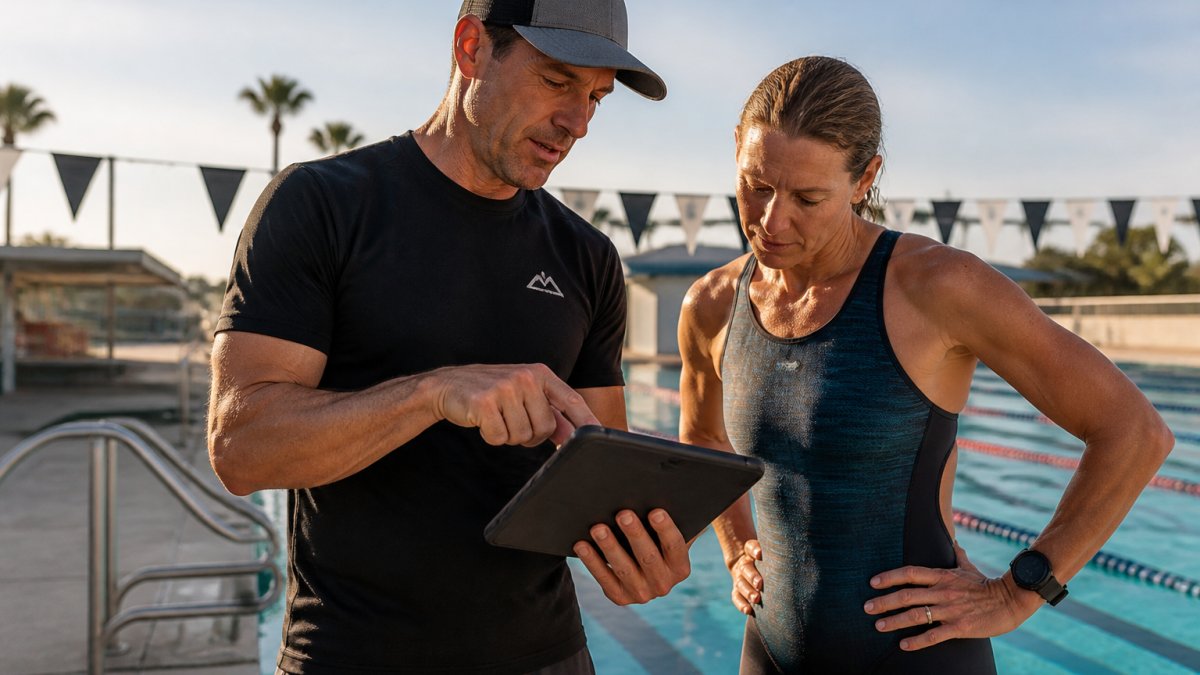
Timeline matters enormously. With 16 weeks to race day, you need a coach who understands crash preparation; with 12 months, you can build a gradual periodized program.
Questions to Ask a Potential Triathlon Coach
Before you commit, get answers to these questions and compare responses across multiple coaches.
Customization and real-world constraints: How do you handle work travel, illness, injury, or two missed weeks?
Nutrition and race-day strategy: Is nutrition guidance included or separate, and will you help build a race-day fueling plan?
Accountability and motivation: How do you prevent burnout and handle drops in motivation?
Coach Credentials, Certifications, and Proven Track Record
Certifications matter but aren't the whole story. A USA Triathlon Level 2 coach has passed a structured exam and understands endurance training principles, but certification alone doesn't prove skill with age group athletes specifically.
Look for USAT Level 2 or 3, IRONMAN University certification, or recognized coaching education. Also ask about their personal racing background: a coach who has raced Ironman has felt the wall at mile 18 and struggled with bike nutrition, and that lived experience shapes better coaching.
Ask for references, a good coach will provide three to five.
Triathlon Coaching Costs for Ironman and Contract Terms
Coaching is a multi-month commitment and the billing model shapes the relationship. Here's how to evaluate cost without anchoring on sticker price alone.
The four common billing models
- Monthly subscription. A flat monthly fee for plan delivery, file review, and communication. Most common for age group Ironman athletes, easy to pause or cancel, and it aligns the coach's incentive with keeping you happy month to month.
- Full-season package. One payment for the 16-to-24-week block before your race. The effective monthly rate is lower, but you commit the full amount up front and exit terms matter more.
- Tiered service levels. Typically plan-only (schedule, minimal feedback), standard (plan plus weekly file review and check-ins), and premium (frequent contact, video technique review, race-day support). The price gap between tiers is often larger than the gap in what you actually need.
- Hourly or à la carte. One-off services like a training plan audit, swim stroke video review, or race-day fueling consult, useful if you already have a plan and want a second opinion.
What to ask about what's included
Before comparing prices, normalize them. Ask each coach to list in writing:
- How many plan adjustments per month are included?
- Is file review daily, weekly, or on request?
- Are phone or video calls included, and how many per month?
- Is nutrition guidance part of the fee or billed separately?
- Is race-day strategy (pacing, fueling, transitions) included?
- Do you charge extra for a pre-race call or post-race debrief?
A coach who includes weekly calls and nutrition may cost less per unit of service than a cheaper coach who charges for every add-on.
Contract terms to read carefully
- Notice period. Thirty days' written notice is reasonable; ninety days or "no cancellation" is a red flag for a monthly service.
- Injury or illness pause. Ask whether you can pause the clock if sidelined. A coach who won't pause billing during a documented injury is optimizing for revenue, not you.
- Refund policy. Most coaches don't refund completed months, which is fair. But ask what happens if you cancel mid-month, and whether unused sessions roll over.
- Auto-renewal. Some season packages auto-renew unless you cancel in a window. Calendar the renewal date the day you sign.
- Scope creep. If the contract says "unlimited communication," ask what that means in practice. Unlimited email with a 72-hour response time is different from unlimited text with same-day replies.
Online versus in-person cost math
A practical way to compare
Budget reality check
Coaching is one line in an Ironman budget that also includes race entry, travel, lodging, bike maintenance, and consumables.
USA Triathlon certified coach directory
Online Triathlon Coaching for Age Group Athletes
Online triathlon coaching for age group athletes has matured significantly.
The best online relationships work through clear communication. You submit workouts via a platform like TrainingPeaks; your coach reviews them, comments, and adjusts next week's plan. Crushed the workouts?
Ask: "How quickly do you review workouts and provide feedback?" Daily review is more responsive than weekly.
Online coaching also removes geographic limits, opening access to specialists: coaches with deep Ironman preparation experience, swim technique experts, and coaches who excel at managing training volume for busy professionals.
Red Flags and When to Change Coaches
Most articles say trust your gut, not actionable. Here's a framework with measurable criteria, plus warning signs that should trigger a change.
Measure the relationship, not just the workouts
You can evaluate coaching quality without waiting for race day. Track four indicators over a four-to-six week window:
- Response time. How long to reply to a direct question? For a monthly subscription, 24 to 48 hours on weekdays is reasonable. Regularly waiting four or more days means the service level doesn't match the price.
- File review turnaround. After uploading a workout, how long until feedback? Daily is premium-tier, weekly is standard, and "I'll look at it eventually" is not coaching.
- Plan adherence fit. Are the workouts realistic for your week? If you consistently complete only 60 percent because volume doesn't fit your life, the plan is wrong, not you. A good coach adjusts within one to two weeks of seeing the pattern.
- Progress markers. Are baseline metrics moving the right way, swim pace per 100 yards, bike power or pace at a given heart rate, run pace at a given effort? You don't need race results, just consistent testing and a coach who references the data.
Concrete red flags
- Generic plans. If your plan is a template with your name on it that ignores your test results, schedule, and injury history, you're paying for a PDF, not coaching.
- No adjustment after missed training. A coach who ignores a missed week and moves to the next block isn't managing your load.
- Pressure to train through injury. Pain that changes your gait, swelling, or a suspected stress injury should trigger a physician or physical therapist referral, not a pep talk. A coach who says push through is a liability.
- Unclear communication expectations. If you don't know when you'll hear back or whether texts are welcome, the relationship drifts. Ambiguity favors the coach, not you.
- One-way communication. Plans in, files up, silence between, that's a plan delivery service, not coaching.
- Dismissed questions. A coach who treats questions as doubt, or can't explain a workout's reasoning, isn't teaching you anything.
When to have the conversation versus when to leave
Not every problem is a dealbreaker. Use this framework:
- Talk directly first if the issue is communication frequency, plan fit, or one missed adjustment. A clear request ("I need file feedback within 48 hours") often fixes it.
- Escalate in writing if nothing changes within two weeks. Put expectations in an email so there's a record.
- Leave if the coach dismisses concerns, pressures you to train through injury, won't adjust a plan that doesn't fit your life, or if two or more indicators stay off after you've raised them.
How to leave well
Give written notice per your contract, request your training data in a portable format, and ask for a short summary of where you are in the block so your next coach can pick up without starting over.
A note on switching mid-block
Changing coaches 8 to 12 weeks out is disruptive but sometimes necessary. Prioritize a coach who honors the fitness you've built rather than restarting you at week one.
USA Triathlon coach code of ethics
Frequently Asked Questions
How much does it cost to hire a triathlon coach for Ironman?
Coaching costs vary based on the coach's experience, training format, and program structure. Pricing depends on whether you choose one-on-one coaching, small group coaching, or hybrid models, as well as the duration of your training cycle. For current pricing and customized quotes tailored to your needs, visit Peak Coaching's website or contact them directly to discuss options that fit your budget and training goals.
What should I look for when hiring a triathlon coach?
Look for coaches with proven Ironman experience, relevant certifications from recognized organizations, and a coaching philosophy that matches your goals. Ask about their athlete-to-coach ratio, communication frequency, and how they handle real-life constraints like travel and family commitments. Request references from current or past athletes, and evaluate whether their approach to training volume and intensity aligns with your lifestyle and experience level.
How does online triathlon coaching work for age group athletes?
Online coaching delivers personalized training plans through digital platforms, with coaches providing feedback on workout data, video form analysis, and regular check-ins. Age group athletes benefit from flexible scheduling that accommodates work and family, while coaches monitor progress through training software and adjust workouts based on your performance. Communication typically happens via email, video calls, or messaging apps, allowing coaches to stay connected without requiring in-person meetings.
What is the difference between a generic training plan and one-on-one coaching?
Generic plans follow a fixed progression regardless of your individual circumstances, while one-on-one coaching adapts in real time to your fitness, schedule, and life events. A coach adjusts training volume when you travel for work, modifies intensity based on your recovery, and provides technique feedback specific to your weaknesses. This personalized approach addresses the core issue busy professionals face: a plan that actually works around your real life, not just on paper.
How do I know if I am ready for an Ironman coach?
You're ready for coaching when you've completed a sprint or Olympic distance triathlon and have consistent training experience, or when you're committed to completing your first Ironman within 12-18 months. Coaching is most effective if you can dedicate 8-12 hours per week to training and are willing to follow a structured plan. If you're hitting a performance plateau, struggling with technique, or juggling competing priorities while training, a coach can provide the accountability and customization needed to break through.
What credentials should an Ironman coach have?
Look for coaches certified by USA Triathlon (USAT), the National Academy of Sports Medicine (NASM), or other recognized coaching organizations. Ideally, they should have personal Ironman race experience and a track record coaching age group athletes to successful race completion. Ask about their continuing education in endurance training, sports nutrition, and injury prevention. Certifications combined with years of coaching experience and athlete testimonials provide the strongest indicator of competence.
Can a coach help me fix technique issues like weak swimming?
Yes. Experienced triathlon coaches assess your swim, bike, and run technique and provide targeted drills and form cues integrated into your training plan. Many coaches offer video analysis, can recommend technique-focused swim sessions, or connect you with specialists for specific weaknesses. The key is choosing a coach who addresses technique proactively rather than sending generic workout files, and who prioritizes efficiency and injury prevention alongside fitness development.